A Case Study in Campaign Directness

Quite often the constant pressure to refine ‘messages’ leads campaigners to get too clever for their own good.

Sometimes, especially when in doubt, it’s best to say it straight, and simply to do the obvious.  When the people trying to do the communication see their case as obvious and are doing it locally, they are much less likely to over-complicate things or try too hard to be ‘sophisticated’.  Even more so when it’s direct, that is not via third party medium like the newspapers or even a social media channel.  Here’s an example.

defra sucks 1

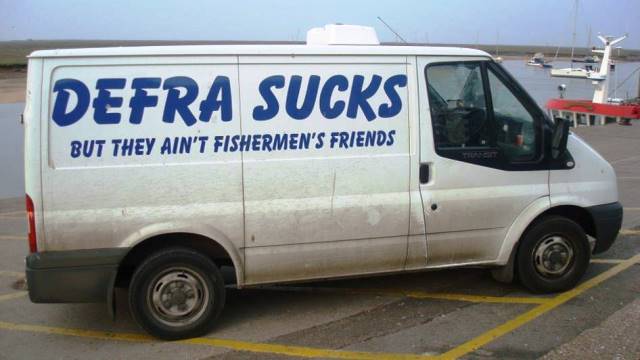
A few years ago a fisherman friend of mine used his van to send a message to the government about his displeasure with their policies.  DEFRA is the English Government’s Department of Food, Environmenat and Rural Affairs.  ‘Fishermen’s Friends’ are a famously fierce throat lozenge long promoted as something allegedly sucked on  by deep sea fishermen.  This iconic British brand has been sold worldwide.  The tin below (image from Wikipedia) is a version from Taiwan.

Fisherman's_Friend_Tin_Taiwan

On the rear of his van he simply wrote this:

wot no quota message

The point being that he’s one of Britain’s many ‘small fishermen’ who have repeatedly lost out to the ‘big fishermen’ in allocation of quotas.  (Following campaigns by small fishermen and environmental NGOs the last ‘reform’ of the EU Common Fisheries Policy was designed to give more quota to small fishers but as it did not lay down exactly how much, the English government effectively ignored it*.  Yet again the small operators lost out.)

My friend’s van is often parked on Wells Quay which in summer is populated by many thousands of visitors.  As a result it became quite well known, and gave some amusement to quite a few people in the fisheries policy community, which is usually a bit short of laughs to say the least.  A wider lesson for campaigns is that the capacity to do direct communications is often a limiting factor.  It’s worth asking yourself what assets and resources you have which might enable you to do this.  Vans on the street are obviously just one example.  And if you don’t have those, who might help your campaign, who does have them ?  Retailers for example, who often have shops and car parks as well as vans.

A year or so later his van had to be retired and he got a new one.  The message however remained the same, although now professionally sign-written:

defra sucks 2

A couple of years further on, and being an entrepreneurial sort of person, he and his partner opened their own restaurant (Wells Crab House Cafe), and he got another van, this time sign-written to advertise the cafe and with a nice picture of his boat, The Blucher (with which he supplied the cafe with locally caught crabs).   There’s no message about DEFRA on the side.

defra sucks 3

But there is on the back.

defar sucks 4

Hes’ now sold the business and gone back to sea.  But I don’t imagine his campaign has ended.

* EU fisheries reform fails to live up to green hopes ENDS Report 493, March 2016

Share
Posted in Uncategorized | Leave a comment

Brexit Puts A Cat Amongst the Green Pigeons

UPDATE 13 June 2016

On 1 June the RSPB and WWF announced that they had changed their position and would make it clear to their 1.7m members/ supporters that on the balance of evidence, it would be better for the UK to remain in the EU.  It seems that in the end, they decided to follow the ‘moral compass’ lead of the Wildlife Trusts (see blog below) and do what is right, even if it might upset some members.

Prime Minister David Cameron who supports staying in the EU, visited Rainham Marshes RSPB Reserve near London on 3 June.  Mike Clark RSPB CEO said “we will not be telling anyone how to vote in the referendum. However, when considering the implications solely for wildlife and the environment, we have concluded that the safer option for nature is for the UK to remain a part of the European Union.”

Cameron said: “EU membership underpins many crucial environmental protections in the UK, while amplifying our voice in the world on vital issues like cutting global emissions”.  WWF and RSPB emphasised that this means support for the EU Birds Directive and Habitats Directive. While Cameron’s words fall short of an outright endorsement of EU green protections they probably indicate some sort of deal with RSPB and WWF to at least change the political mood music on environmental protection, and are in stark contrast with Chancellor George Osborne’s attack on green protections going back to 2012 when he stated  “wildlife protection rules were “placing ridiculous costs on British businesses”.

The bad-mouthing of environmental protection by Cameron and Osborne has involved years of attacking rules as a burden to economic activity and ‘green crap‘ and is an evidence-free zone.  It has been purely political and doctrinaire, a combination of ideological commitment to less regulation such as the ‘Green Tape Challenge‘ which is  part of a ‘better’ (ie less) regulation initiative, and anti-green positioning designed to please right-wing potential UKIP supporters.   The government’s own evidence in fact showed social and economic net benefits of environmental regulation (£3 for each £1 invested) while it’s own case by case study of 26,500 land-use planning decisions found no economic obstacles to business in 99.5% of cases.  That review cited only one such example which was a wind farm refused planning permission on environmental grounds !

The RSPB-WWF announcement leaves the UK environmental movement united in endorsing the value of staying in the EU on conservation grounds, and if it helps a reorientation towards backing green regulations it will have given RSPB and WWF something to show for their efforts.   Presumably Cameron and Osborne did not anticipate that they might need the support of green groups to help swing the EU Referendum.  Whether this kiss-and-make-up comes too late to make much difference, remains to be seen.

———————————————————————————————————-

My last blog ‘The Brexit Values Battle‘ showed how values differences are probably a very strong underlying driver of the UK debate over ‘Brexit’.  It now seems that this divide may be posing a dilemma for some the UK’s environmental NGOs, some of whom have a more values-mixed support base than others.

Broadly speaking, Pioneers and some (Now People) Prospectors will lean towards ‘Remain’ (stay in the EU) and the instinctive support for ‘Leave’ comes from the Settlers and ‘Golden Dreamer’ Prospectors, motivated mainly by a yearning to recover an old national identity.

Greenpeace and Friends of the Earth have both come out strongly in favour of the UK remaining in Europe, because on balance, it seems highly likely that would be better for the environment in the UK and beyond.  Their support base is strongly Pioneer.  Sometimes this is a weakness in terms of gaining broad support (as Pioneers are only about 40% of the population) but it probably makes it much easier to declare a view.

Others such as the National Trust, RSPB, WWF and the Woodland Trust, have discovered that their members are split on the EU issue and some of them vehemently so.  Faced with what some fear could be a damaging divide, they have opted not just to stay out of the campaigning (which all these NGOs have) but not to express a view one way or the other.

This ostentatiously neutral position involves sitting somewhat uncomfortably on the fence because the overwhelming analytical evidence is that leaving the EU would be very high risk for the environment, on matters from nature protection to waste, climate and renewable energy, and pollution.

Of course the staff of these organisations are well aware of this.  There simply is no even half-serious case for thinking that the ‘leave’ option will be better for the environment. Many of its leading proponents are climate sceptic for example and some have shown a visceral dislike of all sorts of ‘greenery’.


soc env ends eu study

Last week the environmental professional’s intelligence magazine ENDS Report  (issue 495) published a hugely detailed poll (893 responses)  of its readers showing they were overwhelmingly (77%) in favour of ‘remain’.  It was commissioned with the Society for the Environment and can be downloaded here.  That poll shows that on measure after measure including non-environmental ones such as attitude to the honesty, efficiency and accountability of the EU, the professionals have a vastly more positive view than the wider public.  Values (a factor in intuitive decision making) will have played a part but direct experience, knowing what really happens through regular involvement, will be the main reason these environmental professionals are so pro-EU.

E4E logo

This is also why a bevy of ex-Chief Executives of environmental NGOs and other environmental luminaries came out as very pro-EU earlier this year in support of E4E, the non-charity campaign group ‘Environmentalists for the Europe’.  The Guardian reported:

Leaving the EU would be damaging for the UK’s environment and quality of life, a group of academics and former high-ranking government officials has said.

“The case is clear: we will be better able to protect the quality of Britain’s environment if we stay in Europe,” said the group, which includes past heads of the RSPB, the National Trust, the Environment Agency and Natural England, in a letter to the environment secretary, Liz Truss.

“Britain’s membership of the EU has had a hugely positive effect on the quality of Britain’s beaches, our water and rivers, our air and many of our rarest birds, plants and animals and their habitats,” the 13 experts wrote.

Of course this doesn’t much help those NGOs who face a dilemma.  Their supporters are vanishingly unlikely to read such material.  Instead they use values (how they feel) and ‘System 1’ heuristics or what Daniel Kahneman calls ‘a mechanism for jumping to conclusions’, to decide about Brexit.

This is why the green NGOs cannot be said to be ‘split’: none are in favour of a leave option.  The divide is between those who have weighed the evidence and shared their conclusions, and those who have the evidence but have chosen to remain silent about what they think.  This may be expedient but is it the right thing to do ?  It’s a dilemma NGOs can face on many different issues.

The Unexpected Case of the Badger That Spoke Out

WTrusts logo

Greenpeace and Friends of the Earth are campaign groups which are used to dealing with controversy on a daily basis but the same cannot be said of Britain’s Wildlife Trusts.  They are normally one of the quieter organisations with a much lower profile than say the RSPB or the National Trust.  Perhaps they had in mind Kenneth Grahame’s Wind in the Willows when they chose a badger for their logo, for that character says “No animal, according to the rules of animal-etiquette, is ever expected to do anything strenuous, or heroic, or even moderately active during the off-season of winter.”

Yet this spring the Wildlife Trusts spoke out very clearly on whether or not it was best for Britain’s environment if we were to stay in the EU:

In accordance with its charitable objects “to promote the conservation and study of nature” and in keeping with Charity Commission guidelines, the UK Council of The Wildlife Trusts has considered how the outcome of this Referendum may affect nature and decided to make its conclusions publicly available …

The Wildlife Trusts believe that our wildlife and habitats will be better off if they continue to benefit from EU environmental legislation and a cross-Europe framework for nature conservation. We have formed this view because of the positive impact they currently bring to the UK’s wildlife and the uncertainty of the alternatives

It hasn’t exactly been a silent spring on the topic for groups like the RSPB and WWF which have so far adopted the fence-sitting position but they have chosen not to reach a ‘view’ and instead to call for ‘more information’ from the Leave and Remain camps about what they would do for the environment.  To my mind, this is not really the issue.  Even if such information is as objective as independent studies, which seems unlikely, their followers and the wider public look to such NGOs as brand trusted to analyse the wealth of evidence that ordinary members of the public have neither the time nor capacity to do, and at least tell them whether they think that on the balance of evidence, it would be better to stay in or get out.

It’s one thing for groups like WWF and RSPB to say that they will not campaign on the EU question, or that it’s not their job to ‘tell people how to vote’ but to my mind it is their job to speak out on the evidence.  RSPB for instance has a pro-wind/ renewable energy policy although that was a divisive issue and UKIP for instance wants to bring back coal.

The strange thing is that the Wildlife Trusts, RSPB and WWF all quote extensively from the same study they jointly commissioned from the authoritative Institute for European Environmental Policy, as the basis of their current positions.  Anyone reading that very detailed report could be in no doubt as to what the evidence shows. For instance on p 48 it concludes:

Under Scenario 2 (entirely outside), most of environment legislation would no longer apply, and the UK would be free to relax and lower environmental standards, creating as a result a scenario with real and uncertain environmental and health risks

Several other expert analyses and Parliamentary studies reach similar conclusions.

The Known Knowns: Dirty Man of Europe

Donald Rumsfield was much pilloried for his inscrutable remarks about the ‘unknown unknowns’ in war scenarios (although he had a point) and nobody knows for sure what would actually happen to the environment in the event of Britain staying in or leaving, not least because that depends upon politicians.

What we do know for sure is Britain’s track record in the EU, which has all too often been one of trying to resist, stifle, ignore or opt out of progressive environmental policies, often while disingenously trying to hold the moral high ground by claiming to have a better idea.

This attitude and behaviour as much as it’s actual poor environmental performance was why in the 1980s it got the reputation as ‘The Dirty Man of Europe’.

dirty man of europe book

I wrote a book called The Dirty Man of Europe (Simon and Schuster), about it, published back in 1990. On page three it stated:

‘From entering the [European] Community in 1973 to the end of the 1980s, Britain was in increasingly frequent conflict with the European Commission and its European partners over the environment.  At the time of writing, for example, Britain faces the possibility of legal action by the European Court over the contamination of groundwater by pesticides and of drinking water by nitrates.

Without pressure from Europe, it is difficult to see how Britain would have made any environmental progress (possibly with the exception of curbing radioactive emissions) in the 1980s.  Britain had the legal and administrative machinery to require FGD on power stations but, before an EC Directive was drafted, showed no signs of using it; even small pilot schemes in the 1950s were shut down.  Left to its own devices, Britain would probably still be setting standards for fumes from diesel engines by running lorries past people sitting in deckchairs (the EC will instead require specific, measurable emission limits).’

[The deck chairs thing is not a joke].

The rest of the 320 pages explored the track record of the UK Government on the gamut of pollution issues in more exhaustive detail than I could be bothered with today.  It’s a ripping read and I thoroughly recommend it, especially the 34 pages of references.

All in all has anything really changed in the intervening decades ?  Not really.  On a long list of green issues from air pollution emissions to neonicotinoid pesticides, the UK has often been obstructive in the EU.

The basic problem is that Britain the nation has never been as ‘green’ as its NW European neighbours such as Germany and Denmark, and  to be so has been out of step with the mainstream in both the two main political parties, Labour and Conservative.  Of the two, the Tories have tended to be the worst but there’s little to chose between them.  Senior British politicians who really stand up for the environment have been the exception rather than the rule.

So the simple answer to the question, ‘would it be better or worse for our environment if Britain left the EU’, is easy to answer.   It would be worse because Britain would be left to its own devices.   Or rather England would, for both Scotland and Wales have started to become ‘more European’ in their attitudes to the environment, nature, pollution and so forth.  This is another big reason why sitting on the fence is on the issue not a very convincing position: to ignore the UK’s track record in Europe in the hope that Brexit would be accompanied by a Damscene conversion of green-haters into greenies also requires hiding your head in the sand at the same time.

The Cat Factor

So what’s kept some of the green pigeons sat on the fence ?  I fear it’s the cat factor.  All NGOs involved in seeking change have to triage opportunities and challenges when it comes to deciding whether to take risks or expend resources: things we don’t need to try and change, things we could change, things we couldn’t change if we tried.  Fair enough but sometimes you also have to do what is right, even if it looks very risky or hard to change.

Cats are an example.  Britain is known as a nation of pet lovers and many cat owners make little distinction between loving cats and loving other animals, eg birds.  This is may well be the reason why neither WWF and RSPB has to my knowledge ever done anything very proactive about the cat problem in the UK.

fat cat no bell

Domestic cats are non-native introduced species. Evidence from a Mammal Society study found:

‘the British population of approximately 9 million cats was estimated to have brought home in the order of 92 (85-100) million prey items in the period of this survey, including 57 (52-63) million mammals, 27 (25-29) million birds and 5 (4-6) million reptiles and amphibians’.  

Brought home dead of course.  By any standards that’s quite a lot.  And that’s without any they snacked on while away from home.  Plus they are also progressively wiping out the native Wildcat as a genetically distinct species by inter-breeding.

The obvious question for any NGO, is ‘what would our members think ?’ if we launched a campaign about cats.  The shortcut way to answer this is simply to ask ‘how many of our supporters have cats ?’ – answer quite enough not to want to go there.

This goes some way to explain why our woodland nature reseves are studded with high seats from which to cull introduced Muntjac deer, large sums are invested in anti-grey Squirrel campaigns in favour of native reds, extinction programmes are set up to eliminate introduced American crayfish from water catchments, and we have traps for Mink but cat flaps for cats.  The cat evidence is essentially ignored.

[The RSPB cites the above study and says there is no evidence that cats are causing declines in bird species that do not often come across cats.  The Society also argues that cats often take young birds (amongst which there is high mortality anyway) or sickly ones but that’s true of many predators.    It does sell cat deterrents for gardeners (‘what you can do to help’).  I find it unconvincing that so many cats killing so many birds and animals in effect, has no effect.  Lack of studies rather than lack of impact probably best supports such a conclusion.]

fat cat bell

Putting a bell on a cat is said to reduce bird kill per cat by about 30%.  Not having a cat cuts it by 100%

Setting aside my personal enthusiasm for a well-structured campaign to start reigning in cats, I think it would be entirely understandable if the green groups sitting on the fence are concerned that they might lose some support, maybe legacies and donations, if they were to inflame pro-Brexit members by going public with their analysis of the evidence on the Leave or Remain question.  But this is a much more important issue, with a huge amount evidence, than even the cat problem.  And in most such cases what feels like a torrent of complaints often turns out to be a trickle of desertions so long as your actions are based on your values and mission (see below).

In the Final Analysis

This is one of those questions where what you decide to do, depends on how you decide.  All ’cause’ organisations need two ways of deciding: by strategy (what’s effective) and by morals or ethics (what’s right).

chart graphic

What’s the best route to take ?

Making strategy is like making and using a map to chart the best route to your objective, preferably along a Critical Path.

Ideally what’s effective coincides with what’s right but sometimes, due to lack of certainty or information or extreme urgency or importance, you have to do what’s right, even if you don’t know it will be effective.  Then you need a compass, an ethical or moral guide that simply says ‘this is the right way to go’.

 compass graphic

Which is the right way to go ?

There is no doubt that the EU in/out question is an almighty mess and divisive, even in families (eg Boris Johnson, an outer, versus both his brother a pro-EU Minister and his dad Stanley who is an in-er and a founder of E4E).  And it’s ironic that the Remain camp of the Government now wants NGOs to speak out in favour of staying in but has frightened the life out of them by a campaign of vilification against charities (in order, it’s rumoured, to reduce any influence they have at the next election) and a lot of restrictive new rules.

But whatever the result of the Referendum, environmental NGOs are going to have to live with the politicians now taking sides.  All of them have had run in’s with government before: taking them to Judicial Review for example.  It’s also true there are a lot of instinctive pro and anti Europeans in the UK, and the latter are a lot crosser about the whole thing but there are also a lot of undecideds.   And although whatever green groups say is not in itself going to decide the issue one way or the other, if organisations which exist to pursue a cause and which want evidence based policy from governments, do not themselves weigh up the evidence and at least share the result, that is not a good thing.

WWF, the RSPB and the Wildlife Trusts have asked the Leave and Remain campaigns to say what they will do for the environment, so there is still time for them all to arrive at a considered view on whether the evidence shows in or out looks better, in the coming weeks.  I hope they do.

Share
Posted in Uncategorized | 1 Comment

The Brexit Values Battle

Slide1

UK political classes and media are gripped by the ins and outs of the Brexit battle (a referendum of Britain’s continued membership of the European Union is due to be held on June 23rd).  Many other Europeans are baffled, not least because the politics are entangled with a very British Conservative Party leadership struggle, and because both Labour and Conservatives are split on the Brexit issue.  But values research from CDSM shows that values differences underly the polarised ‘leave’ or ‘remain’ positions in the UK, and, similar political-values antagonisms are at work in several other EU countries, including on immigration.

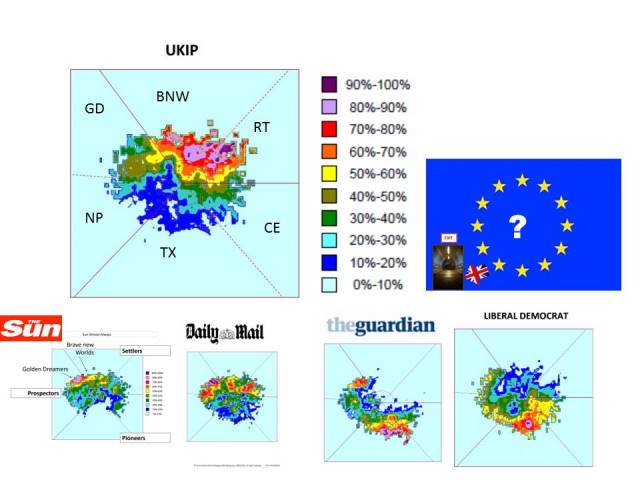
The UK party specifically associated with Brexit is UKIP.  Below is the UKIP vote from around the time of the last election, along with the core readerships of several national newspapers and the Liberal Democrats, longstanding supporters of EU membership.

Slide3

UKIP’s core vote was concentrated in the Settlers (top and top right), overlapping with the base of the Daily Mail and The Sun. The Liberal Democrats and The Guardian mostly show the opposite pattern: their support being concentrated lower right in the Pioneers.   In between the two are the Prospectors, likely to be the swing voters in the Referendum (as a previous blog described, values surveys before and at the last election commissioned by John Cruddas MP showed how the Labour Party lost much of the Prospector vote, and lost the election).

CDSM’s model is calibrated with the internationally verified values model of Shalom Schwartz.  The polar antagonism in values is shown in the red line below: “power” versus “universalism”.

Slide4

Whoever manages to appeal to the values left of this line, such as achievement hedonism, stimulation and self direction, is likely to swing the decision.  In political parlance this means establishing a ‘narrative’ of optimism, the prospects of future success, enjoyment and looking good, whether as a country, a business or individually.  Further appealing to the ends of this polarity will only entrench it and may even turn off the bulk of Prospectors, leading them to stay away on referendum day.

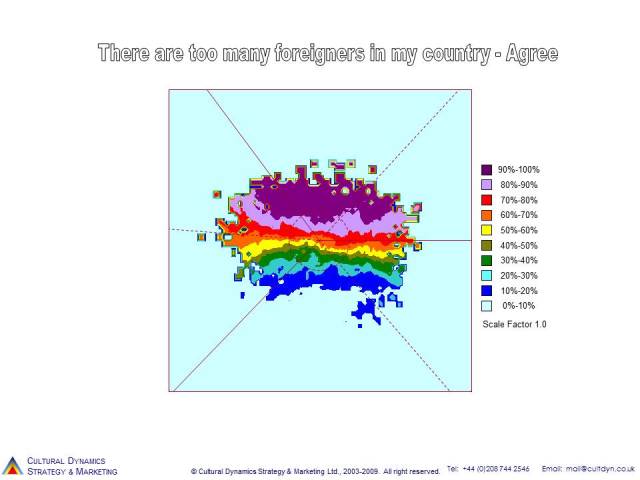
A ‘key issue’ has been immigration.  UK Settlers overwhelmingly agree there are ‘too many foreigners’ in the UK.  This is a reflexive judgement caused by unmet needs for safety, security and identity, and fear of the unknown.

Slide2

UKIP has successfully played on this concern.  Attacking it on universalist grounds and with ‘facts’ will not make any difference, except possibly to drive entrenched views deeper.

How The Remain Campaign Could Win

Only an optimistic success-oriented alternative is likely to make a difference.  A key group will be the Golden Dreamers (GDs above), who are in turn very influenced by the Now People (NPs above) Prospectors, who having achieved esteem of others, are role models for GDs.  The NPs are more fashionable, confident, optimistic and less disciplinarian.  The benefits of Euro-railing, enjoyment of foreign holidays, making friends and having a good time doing business with Europe, and the endorsement of celebrities for the same, are likely to have more effect on this than any amount of ‘economic argument’.

AfD in Germany

In a recent article Alternative for Germany – how far can it go ? at the CDSM research website shows that the recently successful AfD or Alternative for Deutschland party has a very similar values appeal to UKIP.  Such parties are usually called “right wing nationalistic” parties but in truth they are more Settler identity-seeking parties.  Below: core AfD base in December 2015.

AfD

The indexes mean support is above or below average (100 = average).  Dade also points out that AfD’s vote overlaps with wider German concern about ‘too many foreigners’ and this means it could:

‘significantly increase the size of its franchise in a very short period of time – taking it from a fringe party to one that could have significant part to play in a larger coalition with another party or parties. Perhaps more importantly, AfD is well placed to become the voice of these disenfranchised, alienated, angry and frightened people who may not have voted in the past but now feel that there is a party which understands them. If this is so, and they give AfD their vote, they will change the overall narrative within the whole German political system’.

In Britain this opportunity may come on June 23rd if the ‘remain campaign’ does not get its act together.  (For more on AfD read Pat Dade’s piece and for anyone who sees a similarity with Donald Trump’s approach in the US, have a look at his older analysis of the Tea Party).

EU Views and Values Differences

CDSM’s 2015 survey of five EU Member States (UK, Germany, Spain, Italy and France’ – data here) also tested agreement or disagreement (on a six point scale) with the statement ‘On Balance the EU is a Net Benefit’.

This is obviously relevant to Brexit and other possible ‘xits.  Pat Dade will be posting a proper analysis of this in the next week or so but he has let me have some slides to share here (please contact him directly for more).

Here are the pro European values maps – those who agree the EU is a net benefit.

Slide15

Italy: the Pioneers and NP Now People Prospectors (to their left on the map) are most convinced.  There is also a pro EU skew amongst the C1s and ABs (socio economic group).  Overall support is 43.8%

Slide9

France: 45.6% overall support and a similar pattern.  The Settlers and Golden Dreamer Prospectors are much less supportive than the Pioneers and Now People.

Slide6

Germany: 61.6% agree overall but Settlers much less so.  Golden Dreamers are split over the question.  Now People and Pioneers agree most.

Slide12

In Spain there is mass acceptance, it’s a mainstream view, although even higher amongst ABs.

Slide3

Finally, back to the land of the Brexit debate: UK.

Support for the EU is almost the mirror image of those who most support UKIP and feel there are too many foreigners in the country.  The Now People (lower left) are significantly more pro European than the Golden Dreamers (upper left), showing why this is the key battleground that will probably determine whether Britain votes in or out.

Behind these ‘terrain maps’ is a lot more detail which Pat Dade will explore in his forthcoming analysis at www.cultdyn.co.uk, where you can also test your own values using their online questionnaire.

For more on how values shape many issues in our societies see my book (avialble at this page or from Amazon etc) What Makes People Tick: The Three Hidden Worlds of Settlers, Prospectors and Pioneers.


Share
Posted in Uncategorized | Leave a comment

Wells Harbour Helps Holidaymakers Avoid Plastic Pollution (updated)

UPDATE 26 March 16 – Easter Weekend

Good Friday was the first busy day for visitors in Wells this spring.  Gillying (crabbing) started in earnest and lots of people were out enjoying catching crabs from the Quay.

DSC_0058

DSC_0092DSC_0091DSC_0146

I went down to take some pictures and saw the first plastic bucket of the season floating off on the tide.  Fortunately Nick the ferryman from www.wellsharbourtours.com was working nearby and he managed to recover it before it got under a pontoon and headed out into the marshes or maybe to open sea.  Unfortunately most times nobody is on hand to pull them out and they become flotsam, floating about on the tide until they break down into small bits, and finally invisible but deadly plastic pollution.

DSC_0084

Oops – some new plastic pollution in the making

DSC_0129

fortunately Nick is working close by

DSC_0121DSC_0122DSC_0123DSC_0126

he crawls under the steps on the pontoon and recovers the rogue bucket.  We also found a plastic creel used to hold line for crabbing, attached to seaweed under the pontoon

DSC_0128

DSC_0138

“We see them all over the marsh and along the creeks” says Nick, who takes visitors on tours of the Harbour.

OLYMPUS DIGITAL CAMERA

Which is how shiny new plastic buckets can quickly end up as dangerous plastic pollution.

bucket decay process

wells harbour office and rescued crab bucket and creel

Ones that didn’t get away

———————————————————————————————————

Every year some 30,000 plastic buckets are thought to be purchased in Wells next the Sea (England) for ‘crabbing’ or ‘gillying’ as it is known locally. These flimsy buckets are often discarded, becoming plastic pollution.  This endangers wildlife and human health.

gillying rubbish_2discarded crabbing buckets and lines picked up from Wells Quay on one summer morning   

Now Wells Harbour has launched a ‘Healthy Harbour’ scheme to enable families intent on crabbing to use eco-friendly wooden creels for the lines and steel buckets.  The Harbour will hire these out with a deposit and recycle any income into public awareness work.

healthy harbour

Read more about the Healthy Harbour initiative here (or www.wellsharbour.co.uk)

OLYMPUS DIGITAL CAMERA

Wells Harbour at high tide with sea lavender on the marsh.  Looks lovely but there’s plastic in the sea

plastic bucket debris wells_2

Plastic bucket found on marsh at Wells

plastic debris wells_2

Part of recreational flotation device found on marsh – more plastic

barnacles on plastic_2

Barnacles and mussels attached to an old plastic drum probably used as a fishing marker found on Wells marsh – eventually even this will break down into tiny plastic fragments.  These end up in fish and seafood.

razor blade in crabbing bucket left on the quay_2

Razorblades for cutting line found in discarded crabbing bucket at Wells

Picture 004_2

McDonalds Happy Meal promotional balloon found on Cromer beach a few miles away.  Happy for whom ?

Share
Posted in Uncategorized | Leave a comment

48 Campaign Strategies

Here’s a list of ‘campaign strategies’. I’m not saying they are the best or the most applicable but they might help in planning or rethinking a campaign.

Some or all can also be seen or used as tactics. Indeed the distinction between tactics and strategy is to some extent situational, as a tactic (a way of doing something or a how-to) used to strategic effect, becomes a strategy. Other times people distinguish them by scale, or may see strategy as about a series of moves to get a big result whereas tactics are more like tools and small moves that can be adopted responsively. I wouldn’t worry too much about defining the difference, although some people do love that sort of discussion.

There are many other lists of strategies, most notably on marketing, warfare and politics, not to mention ecological and evolutionary strategies. Some of these are relevant to civil society campaigns but the underlying predicates are rarely as clear cut or universally applicable. In business for instance the purpose is usually to make money. In war to overcome your opponent by use or threat of force, and gain or hold territory. In politics to get votes, gain or stay in power or be popular to help do that. Those make strategies and results easier to define. NGO or change campaigns are a lot more variable.

This list does not include more systematic attempts to rethink or create your campaign, for example to make an evidence-based Critical Path to change, or to use PSB or RASPB or CAMPCAT, audience research, organisational level campaign strategies, framing, stories, visual language and so on. For more on those see elsewhere at this website (eg planner here) and lots more in my book How to Win Campaigns: Communications for Change.   A subsequent post shares some values strategies.

  1. The Brick in the Pond

This is the very simplest campaign strategy. Start doing something and see what happens: an iterative approach. The intention may be just to ‘put the cat amongst pigeons’ and stir things up a bit, and to learn from how the actors respond. Or to see where you make any progress. It’s often the de facto approach adopted by groups who do not have any ‘strategy’ informed by previous experience or skills but it may also be a justifiable choice for quite ‘sophisticated’ campaigners when the costs of situation analysis, R +D and all the other work that can go into planning a campaign with optimised chances of success, seem higher than the potential benefits. (The other obvious dimension to take into account is risks).

A support-building variant is to do this in a new place but using well proven tactics, just to see who shows up to support you. I’ve seen people do this in ‘new’ countries where it’s hard to locate allies.

  1. Drop a Dead Dog on the Table

Popularised by Australian political spin doctor Lynton Crosby. A ‘shock’ way to stop people talking about something, and so create the opportunity to get them to switch to talking about something else you’d rather they focused on.

  1. RTS

An old favourite of Greenpeace. ‘Return to Sender’. Send the problem back to its maker. For instance company A claims it’s effluent process water is as clean as the river intake it came from, so call them out on this by connecting their ‘out’ pipe to their ‘in’ pipe. Greenpeace once sent a whole train load of toxic waste destined to be dumped in Czechoslovakia, back to Germany. Friends of the Earth famously returned ‘non-returnable’ bottles to Cadbury-Schweppes, the makers.

  1. Diffuse to Acute

Machiavelli and a host of other political operators have noticed that something a lot of people are a bit worried about has nothing like the political potential of something that a smaller number of people are very concerned about. Converting an ‘issue’ from diffuse to acute is strategy to move it up the political agenda.

  1. Build a Majority

Few NGO campaigns actually need to do this, although outsiders often assume it is needed because they transpose assumptions from politics. Even fewer campaign groups have the potential to do it: hence it’s usually a case for alliances and coalitions where it is needed. But many campaigns do need majority support in key areas or at key steps on a pathway.

  1. Add Heuristics

This is a cheap, quick and, at least in theory, an easy way to tune up any campaign communications. Heuristics are ‘rules’ about things that work more than they don’t work, based on cognitive biases (eg social proof, consistency, loss aversion). The simplest is ‘liking’. Make people like you and they are more likely to agree with you or help you.   Lots online about this. See chapter on the more useful ones in How to Win Campaigns’, or Influence the Psychology of Persuasion or Thinking Fast and Slow.

  1. Boot-strapping

Build resources and assets by use of net positive strategies/ tactics. Start with nothing, or not much, and do your campaigning in a way that leaves you with more help, money or other assets and resources than you had before. Then do it again. Being net positive in this way usually requires being more ‘popular’.   Most non-campaign alternatives with the same effect require running a successful business (or illegality !). Some campaigners struggle with the being-popular bit.

  1. Create a Pool to Fish From

Need to find your potential constituency or build a followership or ‘movement’ ? Do something to attract people who see the subject as relevant to them, and then recruit the subset within that who can be aligned to your approach or objective. A get-them-to-come-to-you or to a thing you-have-caused or -created approach.

  1. Make a Halo Campaign

A halo-brand is one that ‘shines the light’ of its desirable properties onto other brands in the same family or ‘guild’. For example a car model which is a market leader, and which has properties that can then be emulated or echoed in other models which are made to look a bit similar. VW famously did this with the Golf (the Passat being a fat squashed Golf, the Polo a shrunken Golf etc, attracting buyers who’d really rather have a Golf but can’t as it’s too small, costly or whatever). Some campaign groups achieve this by accident and many fail to do it at all. It helps a lot because making any subsequent campaign look and feel a bit like a famous campaign that a lot of people liked, makes it easier to gain support, and more likely to be successful because success is expected.

  1. Credibility Jump

Change who you are in a campaign. Useful if your campaign group is doing way too much of the heavy lifting. For instance where governments or businesses are slowly and incrementally responding to your efforts but not actively helping. For example move from advocate to delivery and thereby get a new authority, power or influence. Only works if you are prepared to change roles and resource that.

  1. Put Something at Risk

Your supporters care about what you want to achieve but do the decision-makers ? For instance ask campaigners or supporters what ’s at risk and they are likely to say things like ‘human rights’ or ‘air quality’ or ‘human health’ but the decision maker may be more concerned about reputation, popularity, profits or market share.  Study them and learn what they do care about until you find a way to make your campaign somehow put that at risk.

  1. Invoke Proportional Response

In most democracies (and many non-democratic leaders assiduously try to do the same thing, fearing unpopularity),  there is a norm (social expectation) that if something is wanted enough, leaders should take note and respond proportionately. This is why politicians want to be seen to stay in step with public opinion (responsive, listening, caring): so they have to ’give something’.   It’s both a quantitative (numbers, how many want this ?) and qualitative (who wants it ?) game. This is what underlies the influence of groups like Avaaz and 38 Degrees: aggregators and manifesters of opinion.

  1. The Wedge Issue

A classic strategy in political circles where parties vie to maximise their vote share. By focussing debate on an issue that unites their team but divides the opposition, they aim to emerge as the largest bloc. Generally under-used by NGOs, who often attack a whole sector in their rhetoric when they would better approach it by dividing the opposition, and/or adopting ‘salami tactics’ and taking out one part of the problem at a time.

  1. The Fault Line

This may be used to ‘split the pack’ as in #13 but is more relevant when considering a single target. Assuming you have identified the best target to focus on to get change, learn about their interests and processes and look for a potential fault line or vulnerability. Few organisations are homogenous, most have differences of interest internally. Many balance business or political plays which are potentially in conflict. Examine how you can frame your campaign which plays on a weakness or fault-line which they will recognize.

  1. Trojan Horse

Does what it says on the box.  Get inside the opposition camp by being attractive and then open the door, physically or metaphorically.

  1. Triangulate

Classically used to reframe away from a bipolar issue standoff (eg where you are in a stalemate with a single opponent) by bringing a new actor or target into play. Defensively popular with politicians wanting to reduce your campaign momentum by getting you into conflict with a third party, eg business, the old, young, sick, poor, Father Christmas or cat owners. Useful to create political space for governments to concede to your demands where it is opposed by another important player. For instance conservationists want protection for marine areas and fishermen oppose it. So create a distinction between ‘good’ (less opposed) fishermen and ‘bad’ (opposed) fishermen, perhaps on small-fisher/ big-fisher lines.

  1. Catch People Doing Something Good

A marketer’s approach that can be applied to campaigns. Reach a new audience defined by already doing something (a behaviour) consistent with what you want people to do, or to support. Congratulate them, help them, get them to like you. Show them that people-like-them are for one or another reason also likely to do your thing, and then get them to do that. The second behaviour may be your end destination or a demonstration to others that it is popular. Behaviour repetition or extension rather than complete change.

  1. Stimulate Anticipation-Reaction

Simon Bryceson points out that many political decisions are not a reaction to events but an anticipation of an event happening, and the possible consequences (see his Political Checklist). If you can pull it off, this is often a lot cheaper and easier than trying to force a decision maker to act. They read the signs and make a calculation.  It also means they must understand, or think they understand, your strategy and what you are able to deliver. Campaigners often assume a target must already understand their strategy when that is not the case.

  1. Remind of/invoke Precedent (pattern match)

This can relate to #18 as in “remember the last time they did this ?” but it may not be about you. Nearly every institution or individual decision-maker will have a memory about good or bad past experiences, ‘lessons not to be forgotten’. Find out what these are and brainstorm about how your campaign can hit those nightmare buttons in a good way.  (Can also apply to reminding them of golden moments and pointing out that this is an equivalent opportunity.  If it is).

  1. The Bush Fire

This plays to the advantage of ‘insurgent’ players needing to build bottom- up support, especially across wide areas (geographically or socially).   Especially at the start of a campaign in which your opponents are embedded, established and strongest in a centralised position (eg in the ‘corridors of power’), creating a bushfire of disconnected, distant and hard-to-grasp campaign fronts can be a strategy which creates a dilemma for the other side. They can try to ignore you or they can ‘ride out’ and try to take the bushfires on one at a time but often they do not have the logistical capacity to do that. This needs constantly growing momentum to work (eg divestment), and a will to stay slightly beyond reach. Central co-option can starve the bushfires of oxygen.

  1. The Theft or Takeover

Take something away from your opponent.   Most applicable once a campaign is fairly mature and many options have been explored.   It could be an ally who is persuaded to switch sides, or an asset which is repurposed, as in ‘subvertising’ of ad posters or many of the works on the Yes Men in which they borrow identities or corporate venues.  It can also be a real thing which you use to good effect (and then give back – in English law at least, it’s not actually theft if you don’t intend to permanently deprive the owner of it).

  1. Make the Weather

Another political term with connotations of sorcerers ‘talking up the weather’, which means to create a public conversation or mood, an atmosphere which sets expectations and makes some things harder, others easier. This strategy may be needed to first affect the context so as to raise the chances of success for a more specific subsequent intervention to reach your intended change objective. An allied idea is winning the ‘air war’ or media conversation in a political fight (implying though that this may not win the ‘ground war’ of actual behaviours such as voting).

  1. Get the Door Opened for You

A great many campaigns are oppositional. See the hill, take the hill; batter down the door of the opponent. A more effective strategy may be to explore the possibilities for inducing someone to open the door for you. This usually requires inside knowledge, thoroughly understanding the interests and dynamics at work in the target organisation. Campaign groups which become dogmatic and ideologically opposed to a target they ‘love to hate’ rarely look into such possibilities.

  1. Tactical Positioning

Perhaps the most useful of the many ‘stratagems’ proposed by the much quoted and less-read ancient Chinese master strategist Sun Tzu, in his book The Art of War. This says simply to identify your best tactic, and then plan strategies which enable you to use it. Requires some discipline.

  1. Distraction

Like outflanking, ambushes and surprise, a ‘feint’ or attack designed to draw the enemies attention away from one place to another, is a pretty obvious tactic. That’s one type of distraction but distraction need not involve any sort of offensive move. J K Galbraith describes in the Age of Uncertainty how Karl Marx came to write his crucial document Address to the Working Classes. The ‘First International’ a meeting of the ‘stateless proletarians’ intended to form the Marxist ‘organisational weapon’ was held in 1864. An Address was to be written as the key propagandist tract. Galbraith says Marx was appalled at the ‘verbosity, illiteracy and general crudity’ of the draft. So exploiting his role as Secretary, and ‘knowing the subject to be irresistible’, he ‘got the members discussing rules’. With the members suitably distracted, Marx rewrote the seminal text himself. As any parent discovers, the best type of distraction is one the target enjoys.

  1. Surfing

Some of the most prominent campaigners I know are secret or brazen practitioners of issue surfing. Almost all will pay lip service to the importance of systematic ‘strategy’ but disliking the hard slog and tedium of analysis and planning, they instead become expert in deft exploitation of media trends and opportunities, and social debate. This gets attention but an obvious risk is that it really only feeds the needs of the media or social media, and it is no use in making headway ‘against the current’.   Sometimes it does ‘work’ in more instrumental terms and they manage to use frequent and high profile commentary to influence real outcomes in terms of change.

  1. Explaining

Some politicians and campaigners manage to develop a reputation for explaining events, for being meaning-givers.   It could be said that those ‘think tanks’ which are in effect campaign groups, also do this, as their most high profile and wide-cast interventions are usually to explain events which already have significant attention. This strategy avoids the need to create the events, although it is rarely as potent as one which allows a campaign group to create events ‘at will’. It usually requires a long history of reputation making.

  1. Create a ‘Killing Ground’

In military terms this is self-explanatory: it’s an area where the enemy can be targeted and killed, often by using a feature of topography to determine where to site your forces. The equivalent in campaigning, where the ‘killing’ is only metaphorical,  could be cases such as where an opponent which is generally outside public view or beyond the influence of public judgements (eg do or do not buy their products), can be held to account. This might be a stage in a process or cycle where they are unusually vulnerable, or it might be created by changing the context so that they are unusually exposed.

  1. Attrition

Possibly the dullest, least imaginative and often the crudest of all strategies; intended to wear down or wear away an opponent or obstacle. Got a bad name in World War 1 as generals sent waves of men ‘over the top’ from their trenches to be slaughtered in ‘no man’s land’. On the other hand, it suits organisations with a followership, often fairly closed, which actively enjoys the ‘long march’.  A dumb form involves constant effort but informed persistence, never quite stopping altogether and coming back with a bigger push at times of opportunity, is often vital for the long term success of a campaign. See Daphne Wysham’s almost lone 16 year campaign to get the World Bank to stop financing coal plants.

  1. Entryism

Much loved by the ‘old left’ Trotskyists in the UK, this involves infiltrating organisations (typically unions of political parties) and colonising them from within, before changing their policies.   A similar dynamic though can apply in any organisation open to membership of some sort, for example a company that can simply be bought into, or most political or social organisations. On the other hand in social groups (NGOs are no exception), culture is often harder to change than anything else so it’s often quicker and more effective to establish a new organisation, NGO, business or otherwise.

  1. Drain the Swamp

A strategy of force and often last resort but which even cause groups may find themselves faced by if they cannot for example induce regulators to enforce rules, or ‘rules’ for a sector are only voluntary (as in many certification schemes). A way to identify the last remaining sources of the problem or opponents.

  1. Know More About Your Opponent Than They Do

We’ve all seen those spy movies where the handler or interrogator tries to make the subject feel helpless by revealing something the subject thought was private. The idea is that the hapless subject then believes that “we know everything about you”.  Well it can work in real life.   If you do some good research into customers of companies or politicians voters it can give you some great ideas about how to get them on your side. As well as using it to try and activate support, you should at least consider sharing some of this in a pre-launch meeting with your target. It’s unsettling to discover that campaigners know more about you than you do yourself. What else do they know ?

  1. The Slingshot

A way of boosting momentum.

Wikipedia says:

‘In orbital mechanics and aerospace engineering, a gravitational slingshot, gravity assist maneuver, or swing-by is the use of the relative movement (e.g. orbit around the Sun) and gravity of a planet or other astronomical object to alter the path and speed of a spacecraft, typically in order to save propellant, time, and expense. Gravity assistance can be used to accelerate a spacecraft, that is, to increase or decrease its speed and/or redirect its path.

The “assist” is provided by the motion of the gravitating body as it pulls on the spacecraft.[1] It was used by interplanetary probes from Mariner 10 onwards, including the two Voyager probes’ notable flybys of Jupiter and Saturn’.

And there you go. Point being that by luck, your normally obscure topic of concern may suddenly become highly salient because some newsworthy event means a huge number of people are talking about or looking at it. Or could be made to do so because it is suddenly ‘relevant’. For a (typically very) short period you have an opportunity to dominate mindspace and attention at very little cost in time and effort. Timing is of the essence. An environmental (and rather predictable) example is the Olympics. It’s typically a much bigger ‘issue’ or national concern than the environment but for a short time, ‘the nation’ wants to be ‘the best’ in all things in the ‘eyes of the world’ and so it wants the Olympics to be the best in environmental terms too. Used well, this can have a lasting legacy in terms of greater velocity/ momentum for environmental matters in a country, even redirecting trends or pathways.

  1. Signal the Inevitable

Lets’ face it, in most cases your concern is not uppermost in the minds of mainstream decision makers, otherwise you would not need to be campaigning.   They mostly do not feel that they need to pay attention although they may humour you by the occasional invitation to talk. Unelected politicians are some of the worst, and media are no better: they are mostly ultra-short-term, interested only in how they perform on the day. Governments and some businesses (and investors) however, do plan for the future, at least a bit. This is where analytical evidence can play a role. If you can show that (your desired) change is eventually inevitable, the custodians of the ‘long view’ will start to mark-up your priorities. Back in the 1980s two of the earliest inside-track allies for ‘doing something’ about climate change were the NATO military who had long-trend secret measurements of thinning arctic ice (their preferred hiding place for nuclear missile submarines), and the re-insurance industry (whose existence was and is threatened by increasingly severe weather impacts).

But it’s not pure analytics which is in play here. Concepts like the ‘ratchet of history’ illustrated by lookalike technology change (the horse gave way to the combustion engine car, that will give way to …) are intuitive frames which politicians use to convince themselves and others that some change is inevitable.

  1. Be the Zeitgeist

Be most in step with the public mood. ‘The defining spirit or mood of a particular period of history as shown by the ideas and beliefs of the time: zeitgeist’. If you get known (get a track record) as a group which is one-step-ahead in terms of the developing or breaking public mood or concern, your views and concerns carry weight with those who think that sort of thing is important. And that includes some values groups (see subsequent post), and any company or politician which is playing to the ‘leading edge’ (currently for example, Apple).   Polling plays some role in this.

You don’t have to brilliant at it, only better than your opponent who has to suffer something by not being as good at it. How you do campaigning is important in achieving this.

  1. Shoot the Fox

This involves removing a key point of opposition’s strategy: it is often competitor related (in politics) but as it essentially about removing cause to be concerned or focus attention, it can affect any campaign. See here for a good example from Simon Wright of Save The Children. It can also work the other way round, ie to the advantage of the campaigners.

  1. Smoke Out Silent Beneficiaries

Very often campaign groups struggle away making change and other players benefit.   They may remain the ’silent majority’ but more important, they are silent beneficiaries. Force them to take a view, get them off the fence and you can increase the weight behind your campaign considerably but be careful, as being too belligerent may have the opposite result. Achieving your objective may be hugely important to you but only one of several options to make an advance for them. Often, enabling them to align with your cause without visibly joining it, will make it easier to shift them Natural justice is on your side in these cases because of the effort and exchange heuristics: it’s wrong to gain by others efforts without actually helping yourself. Make it just uncomfortable enough to stop them staying ‘neutral’ or silent. They have usually been lying low and hoping not to be noticed.

  1. Pin the Blame

This is a political favourite and the sort of thing that gets politicians a bad name but almost everybody does it.  Something bad happens: it’s an opportunity to attach the blame, which often has consequences. Don’t be too squeamish.

  1. Shift Dimensions

Effective campaigns usually need to be multi-dimensional and you may have ‘mined’ the potential of one (eg scientific, economic, technical) but not another (eg spiritual, emotional). So a strategy of re-casting the campaign in another dimension may enliven it and open up opportunities to make rapid progress. The main obstacles to this are usually internal.

  1. Change the Players

This is the sort of thing they teach about in business school because a classic example is competition dynamics where a ‘market entrant’ upsets the apple cart. For instance, renewable energy technologies were for decades dominated by enterprises owned by oil companies. Advantage to campaigners trying to get renewables taken seriously: government listened to oil companies. Disadvantage: they had a structural interest in keeping renewables as a ‘bet hedge’ while they mined value from fossil fuels. So levering new players with no such cross interests into the market (eg electronics companies) was a good second step strategy.

  1. Mainstreaming

Few campaigns begin life ‘in the mainstream’. This is partly for reasons of values (to be covered by some strategies in a subsequent list) as well as because most campaigns are about trying to change established (mainstream) practices. Many however reach a point where they need more mainstream support to progress.   The best way to make a ‘message’ mainstream is often to use a mainstream messenger, which may mean starting with one or two ‘messengers’ that mainstream media is interested in or gives space or attention to, for other reasons. This usually means that campaign groups which are not themselves seen as mainstream, have to ‘let go’ of ‘the message’. Campaign groups which intentionally or by default spend most of their effort talking to their existing base, may never achieve this. It can need a deliberate effort and investment, including working with organisations with a broader reach than your own.

  1. Cut off the Means to Persist

A classic military strategy designed to sap the strength or ability of the enemy to continue. Not an attempt to persuade the opponent or to directly overcome them.  An example might be cutting supply lines or some other key factor such as the support of an ally. Campaign planners need to do force field and power analysis to study this, understanding and breaking down the requirements of the opponent’s operation to find one or another element that can be changed. For instance they might rely on the support or involvement of a particular group in society, which may not be aware of your case, so suggesting a new focus in a communications strategy.

  1. Make the Intangible Tangible

Campaigns conceived because of scientific or other ‘expert’ knowledge frequently fail to engage a wider audience because the impact of the problem remains intangible to most people. For example if they do not see evidence of it now, they may assume it only exists elsewhere or in the future or the past, even when they themselves are affected. Making something more visible, or more disruptive to everyday life, are two ways to change this, whether directly or by introducing proxy indicators such as signs of its presence.  Religions do it by having costumes, building temples, creating ceremonies and so on.

  1. Bear Witness

The founding principle of campaigning by the religious group The Quakers.  The Quakers believe that one should be truthful and honest and avoid statements that are technically correct but misleading. In campaigns it has come to mean that if you are present at a point where something wrong is happening you say so, and try to stop it in a non-violent way. If it cannot be stopped, it is at least exposed.   Anti-nuclear Quaker campaigns (which started with the voyage of the Golden Rule in 1958) played a key role in inspiring the formation of Greenpeace (in 1971), which adopted ‘bearing witness’ as a central element of its strategy of non-violent direct action.

  1. Make the ‘Impossible’ Happen

A classic error in campaign planning is to omit from the plan anything that seems impossible. This is where the truisms of politics (the art of the possible) do not transfer to campaigning, which is partly the art of the impossible. Making the ‘impossible’ happen can sometimes be hugely inspirational, even it is only temporary. That can then transform what is possible. There are many things people disapprove of, or would like to happen but which they do nothing about because change seems impossible (‘values expectancy’). Whether by stopping the problem if only momentarily, or implementing a solution, even if it cannot be sustained for an extended period of real time, showing that it can be done, is a powerful way to build a constituency for insisting that it be done.

  1. The Telescope

Campaigns using this strategy bring forwards the future consequences of not acting now and ‘actualise’ it in a compelling way. Or recover something better from the past to show that such a reality could be resurrected or retrieved.

  1. Change the Victim

Campaigns which show that a class of victims are suffering that decision-makers and the audiences they care about have a high empathy with, are more likely to succeed that those where the putative victims are people or things they do not much care about. (Campaigners who want to change who the decision makers or secondary audiences care about need to do that first: just telling them to care is unlikely to work.). A simple example is the baby heuristic.   Humans are hardwired to care about babies (the baby heuristic) and small children, more than they do about other humans, as illustrated by the famous ‘Edinburgh Wallet Experiment’.   So make your campaign about babies as victims and odds are that it will become more effective. [This can also include finding a victim where there appears to be none].

  1. Give Away the Credit

In this strategy you make someone else the beneficiary of you winning, thereby recruiting them into the effort.  Not taking the credit of course has its downsides as if you do it too often, your organisation does not appear to be effective, at least for audiences outside the cognoscenti. It may even involve campaigning to incentivise agreement by putting in work to advance the interests of the decision maker but at the very least, sensible campaigners will thank an organisation or individual which has done what they asked for, and preferably try to enlist them as allies for further change.

———————————————————————————————–

If you have something to add, please leave a comment !

Share
Posted in Uncategorized | 1 Comment

German Small and Medium Sized Businesses Come Out Against TTIP

A survey fielded by the research agency Prognos has found that a majority of Small and Medium Sized Enterprises in Germany are against the controversial US-EU trade deal TTIP.  The European Commission and Member States such as the UK have claimed it will be good for SMEs which form the backbone of European economies and account for most private sector jobs.

As a previous post reported, several thousands SMEs have joined campaigns against TTIP in Austria, Germany and the Netherlands but this survey was of 800 companies within the BVMW, a mainstream German business association. Leader of the BVMW, Mario Ohoven, declared “TTIP must benefit German SMEs – not just the interests of a select few conglomerates”.

Prognos commented: ‘62 percent of companies questioned expect the impact of the agreement to be either “rather negative” or “very negative”. Only 22 percent anticipate a positive impact. Furthermore, German SMEs are not particularly hopeful that the deal will benefit their own businesses. They currently believe that TTIP will mainly benefit large corporations’.

how my company might be affected Prognos

Most SMEs in the survey take a negative view of TTIP regarding their company.

general effect of ttip prognos

Most SMEs are not optimistic about the wider economic impact.


info wanted on ttip prognos

A majority don’t want to hear more from Brussels – they more want to hear from national politicians and business groups.

Results of the Prognos study are posted in detail at the MORE website (a project I work on): How satisfied are SMEs with current free trade policy ? .

Entrepreneur Hans Schöpflin of the Schöpflin Stiftung which part funded the survey said SMEs “fear unfair competition resulting from rules and regulations that exclusively favour large corporations. We cannot allow a situation to develop whereby TTIP and CETA – which only serve to maximise the profits of large corporations – put smaller companies across the whole of Europe under pressure.”

An increasing number of German and Austrian SMEs are campaigning against TTIP – eg see this report from from Deutsche Welle (see full story online here)

https://www.youtube.com/watch?v=A7EzZjH_E-w

The SME dimension has opened up a new BoB or Business-on-Business front in the TTIP debate.   BVMW President Ohovens warns of an imbalance in transatlantic trade: “Unlike Brussels, the US government is not in a position to declare technical standards universally binding. We therefore run the risk of creating a one-­way street in trade which would effectively allow US companies to sell products in the EU that conform only to US standards but by contrast would not allow EU companies to sell their EU-­compliant products in the USA.”   Governments now face a choice.  Multinationals have lots of money but SMEs have lots of votes.  Whether they feel this is a dilemma remains to be seen.

Share
Posted in Uncategorized | Leave a comment

What if we had rejected the government’s smooth invitation ? A Cautionary Tale from Campaign History

recycling bottles foe schweppes

FoE return ‘non-returnable’ bottles to the doorstep of Cadbury-Schweppes in 1971

The Schweppes Bottle Campaign was Friends of the Earth’s first famous campaign and perhaps still it’s most famous image.  I wrote about the power of the image and whether or not the success of the image might have actually got in the way of achieving the desired objective, in a previous blog.

Recently I bumped into Richard Macrory who was Friends of the Earth’s in house lawyer back in the 1970s.  He told me a story about what happened after that iconic ‘return-to- sender’ captured the public imagination, which is a cautionary tale for any campaigner.

It suggests that if FoE had remained more intransigent, the UK Government was about to concede the campaign’s main demand of statutory re-use of bottles but instead it offered a place on a ‘Waste Management Advisory Council‘, which FoE accepted and led not to re-use but to recycling.

______________________________________________________________

‘What if we had rejected the government’s smooth invitation’ ?

Guest Blog by Richard Macrory

Richard Macrory pic

Richard Macrory is now a QC at Brick Court Chambers and Professor of Environmental Law at University College London. He writes:

“I was the in-house lawyer at Friends of the Earth Ltd in the early 1970s when it was still a pretty small organization and one deeply distrusted by Government.

The Schweppes campaign had really put FOE on the map in the UK, and many of my generation who had grown up doubling or trebling their childhood pocket money by collecting and returning glass bottles were deeply offended but the direction of travel towards non-returnables.  When I joined, one of central goals of the Resource Campaign was to secure something similar to the Oregon Bottles Bill 1971 which had introduced compulsory deposits on bottles.

The campaign attracted enormous public support, and at some point the then Department of the Environment approached FOE and said they recognized it was a serious issue but also one that was complex and they were therefore proposing to set up a working party to examine it all in depth, including industry. But they wanted FOE to join the working party.
We had an intense staff debate to decide whether we should join or not.  This, I think, was almost the first time the Government had asked for FOE’s input to such a group.

Some of us were alarmed at the prospect. Were we becoming establishment too soon? I had had some experience of late 60s student politics at university where those in charge used such working groups to put political difficult issues  out to pasture –  everyone got bored talking in detail until it all died away.  Others, including the director Tom Burke, argued forcefully that FOE had always believed in the power of rational argument and facts, here we were being given the opportunity to seriously make our case within government, and we could not duck the responsibility and opportunity.

FOE did indeed decide to join the Working Party (the Waste Management Advisory Council which ran from 1974 to 1990), and as I feared it seemed to sit for ages and ages with little result, and the exciting campaigns on non-returnables simply dissipated.  And maybe there was a sense that these issues often turned out to be more complex that we all initially thought.

Only a few years I met a recently retired civil servant (ironically at a party of Tom Burke’s) and we were comparing notes on our early experience of environmentalism in the UK. It turned out that at the time I was the FOE lawyer,  he was a junior civil servant in the Department of the Environment and had been working on the issue of non-returnable bottles.  He remembered the overture to FOE to join the working party – and then asked me whether I realized that if FOE had turned down the offer, the Government’s response would have been to introduce legislation along the lines of the Oregon Bottles Bill.  They felt we were politically so powerful on the issue that this is what they would have to do, but their first rule of thumb was always to offer a working party to try and diffuse things.

Of course when you are negotiating with government (or indeed anyone) you have very little real idea of your real power, and at what point you should accept a compromise or refuse to talk. It’s a constant challenge. Now it may be that such a Bill would not have survived scrutiny under EU law on free movement of goods – Britain had only recently joined the Common Market and officials were probably blissfully unaware of the constraints the Treaty could put on national initiatives – just over ten years later, the European Court in 1988 held Danish legislation on returnable bottles contrary principles of European law.  But if only we had rejected Government’s smooth invitation  there might have been a few years of an environmental progressive law  on the issue”.

______________________________________________________________

My thoughts:

Schhh poster

But they did … and we’ve been trying to recycle it ever since.


FoE waste hierarchy

C21st FoE resources campaign slide

The objective of the Schweppes  action and the resources campaign was re-use but what FoE got was a recycling industry.  Once that was in place it proved very hard to push designers and decision-makers in industry and government, back up the waste hierarchy.  Investment in recycling facilities created a lock-in and defining recycling as a social good thing meant the memory of returnable containers faded.  Of course as Richard points out, nobody can say quite what would have happened had the British Government introduced that Bill but it might have been an even bigger success for FoE than the famous photo.


Share
Posted in Uncategorized | 1 Comment

UK Charity Types by Motivational Value

Update 26/2/16 Here is a crude summary slide of some of the examples positioned by their maximum point of agreement

summary charity favourites examples_2

The functional-emotional nature of these charities reflects the different unmet needs, attitudes and beliefs of the three Maslow Groups.  Settler favourite types are very much about survival, safety and security.  Their primary scope is very much kith and kin, our people.  The Prospector charities are more consistent with enabling success in life, potentially getting something back for yourself or your children, and becoming less Settler and more Pioneer as you move towards the Pioneers.  The Pioneer charities are ones that require or enable ‘giving back’, and are ‘big picture’ consistent with the importance to Pioneers of universalism.

Update 18/2/16:  Here Favourite UK Charities by Values 2014 detailed you can find the full data on which the slides are based, as background or for more info..  For 2015 data or technical questions contact CDSM

Update 12/2/25: please note that the results for ‘International’ category do not seem to make sense in values terms.  This is because the description of the option was simply ‘International charity’ which can mean a lot of different things to respondents.  The category options were not generated by CDSM, which simply fielded a list provided by a client agency.  Qualitative work with the respondents would be needed to unpick why this got the responses it did.  The Overseas Aid option is a clearer test of the values function of dealing with ‘big global’ issues, along with ‘Environment’ which at the time of this survey was often treated as synonymous with climate change and other ‘global’ environmental issues.

———————————————————————————————————-

Analysis drawn from the 2014 British Values Survey by CDSM reveals that choices of ‘favourite charity types’ reflect strong preferences based on unconscious motivational needs.   A nationally representative sample chose their ‘top five’ charity types from a list.

The most popular charity type in the UK is ‘animal charities’ (no surprise there) which has such broad appeal that it is effectively cross-values.  However most charity types show much distinct values profiles, for instance environment and human rights are strongly Pioneer reflecting values such as Nature and Universalism.  These are essentially give-back rather than get-back and pro-change charity types.  Settler skewed charities tend to be focused on straightforward survival-assistance and security (eg ex Armed Services) and Prospector skewed charities on enabling success (eg Health, Education).  Simple stuff really.  (See slides above).

Slide13

Slide12

Slide10

It is very likely that support for individual brand charities within these broad types generally reflect these values differences in most cases, although there may be narrower or wider skews to one or another Maslow Group within a set of charities in a sector, depending on how they go about their business, as that will exert a values-filtering effect.

Below – some Gradient Map examples showing strength of preferences across the Values Map

Slide18

Slide33

Slide29

Slide20

Slide22

Although there will be cultural inter-country differences these will probably be mainly nuances on this picture as the motivational values are universally applicable.

The slides give examples of how the Attribute maps (details of the values survey results) can be used to create specific values-resonant propositions, eg in copy writing.

Slide50

Slide51

Thanks to CDSM for permission to share these data.

Share
Posted in Uncategorized | Leave a comment

After Paris, Climate is A Question of Freedom

Achievement of the Paris agreement on climate change leaves those against effective global action on climate positioned as alongside ISIS.  It effectively brackets fossil fuels with tobacco and slavery.  Climate campaigns must now hold politicians to account and drive home these moral imperatives in simple terms.


At the 2015 climate conference in Paris, the world’s governments shifted from being uncommitted to doing the right thing, to commitment.   It was historic and it was positive but as Kumi Naidoo and many others said, it was a lifeline not a rescue for the planet.   There is no agreed package of measures which will achieve the goal of limiting the human warming of the earth to an average 1.5C above pre-industrial levels, only a political acknowledgement that this should be done, 23 years after governments adopted the UNFCCC, a mechanism designed to do just that. As the UN states:

The ultimate objective of the Convention is to stabilize greenhouse gas concentrations “at a level that would prevent dangerous anthropogenic (human induced) interference with the climate system.” It states that “such a level should be achieved within a time-frame sufficient to allow ecosystems to adapt naturally to climate change, to ensure that food production is not threatened, and to enable economic development to proceed in a sustainable manner.”

That meant and means 1.5.C and 23 years is quite a long time to take before deciding to acknowledge that and to pick up the tool and use it, but it was always a big ask.

Whether or not political commitment has come too late or not to achieve this, campaigning will have to continue, and now it means closing the gap between a political intent, and political action.  Campaigns can play a role in the host of efforts required to ratchet the change needed: technological, regulatory, behavioural, perceptual and others. Deciding where to place the efforts is a mind-stretching task in itself.  What happened in Paris is the the only factor that should guide this but it is worth considering, as politicians seeded a powerful new ‘narrative’ in Paris.

Using What ‘Paris’ Did

The Paris outcome has left governments as a whole facing in the right direction, unlike what happened in Copenhagen in 2009. It has changed the political weather on climate because it was not possible to go along with the general consensus while remaining even ambivalent about the science.  Scepticism is effectively dead: the centre of gravity in media and political discourses has now fallen into line with the perceptions of publics and those of the business world outside the fossil fuel industries.

Fossil fuel companies realize they are now tobacco-like pariahs. A friend of mine who recently gave a talk to Shell executives told me that he found them a ‘company in the midst of a nervous breakdown’. Brian Ricketts, Secretary General of the coal industry’s European lobbying association Euracoal responded to the Paris agreement by saying coal producers “will be hated and vilified, in the same way that slave traders were once hated and vilified”. He fears that Paris positioned fossil fuels as “public enemy number one”.

It is plain that the fossil fuel industry has lost a huge amount of political equity that can never be regained. Campaigns against it need to continue. It is fatally weakened.  As John Kenneth Galbriath said: ‘all successful revolutions are the kicking in of a rotten door’ but it still needs kicking flat and quickly.

The tobacco analogy has long circulated in the ambitions of campaigners against fossil fuels, de-socialisation of fossil fuels is something that campaigns can leverage if not fully deliver, and now it will be harder for governments to stand in the way or just stand aside.   Even in backwaters like the UK where our antediluvian Chancellor George Osborne bizarrely promotes fossil fuels and tries to sabotage renewable energy, because of Paris and social-market forces beyond his control, the tide will run still faster against fossil fuels.

Of course we cannot afford for ‘tobacco control’ to become the model of delivery: it was decades too slow. But we should use similar signals of what needs to happen. Why, for example, should fossil companies any longer be allowed to advertise, without even any ‘health warnings’ ? How can that be in the public interest ?   As Euracoal’s Brian Ricketts might fear politicians will say, why should consumers remain enslaved to fossil fuels ? Politicians must be helped, encouraged and made to break those chains. Being free from the threat of worse climate change means being free from fossil fuels.  It’s a question of freedom.

So why did governments pull together in Paris when they did not before ? Was it to make good on their failure in Copenhagen, or because renewables are now more plainly the viable alternative and vigorously embraced by China and the US, or because they had discovered that scientists were right all along, or that their voters have noticed the world’s weather is going haywire ? All those things helped but in Paris there was one acute political need, lacking in Copenhagen, and that was to show that international state level politics can still ‘work’.

The leaders who gathered in Paris were spooked by the horror of the ISIS attacks, and US President Obama made it a case of rejecting-terrorism-by-saving-the-climate, asking “what greater rejection of those who would tear down our world than marshaling our best efforts to save it” ?

What greater example is there of the power of context ? On one thing though, Mr Ricketts was wrong.  For political leaders the number one public enemy was not climate change but ISIS. It’s just that the need for international action brought them together.

The political imperative to stand alongside France, and especially the show support for bloodied Paris, was turned into an imperative to reach agreement on climate action. By all accounts the French diplomats excelled themselves in negotiation and making best use of the counter-ISIS dividend.

So it is, that through the taking of sides, those against an effective international agreement on climate now find themselves counted alongside the oil-funded terrorists of ISIS. Politicians need to be constantly reminded of this.


Share
Posted in Uncategorized | Leave a comment

Trouble With Stories

Chris Rose

(You can also download this blog as a pdf)

I have to confess that for the past several years, something has been worrying me about stories. Not stories in general: like everyone I guess, I love stories. It’s only human to do so.

It’s stories-in-campaigning that worry me but not even just that as such. I’m a ‘believer’ in their power and have my own pet lists of useful things campaigners ought to know about stories[1]. I’ve long tried to emphasise to would-be campaigners that the two most important things in communicating for campaigns are to use stories, preferably involving real people, and to communicate through pictures.

It’s more about the contemporary fashion for stories, or rather for adopting techniques of ‘story-telling’, which to me at least, sometimes seems to have become more than a tool and almost grown into a belief-system. When I hear that ‘great story-telling will lead to ‘great campaigns’, something shouts at me that this isn’t right. Not on its own.  So great is the vogue for having a campaign composed of great story-telling that I have seen almost any sort of campaign communications which campaigners are proud of, described as ‘great storytelling’; from linear videos, to photo-calls, to print adverts to physical actions, to infographics.

Asking for Help

Some readers of Campaign Strategy Newsletter may remember that a couple of editions ago I asked for help. Did anyone have evidence of where story-telling had actually produced results in campaigning ? I didn’t really doubt that they had but I wanted to know how they had, and how we knew they had.

Thank you to those who took the time and trouble to write to me[i].

This wasn’t the first time I asked, and I’ve been sent lots of links to some of the mountains of evidence of how stories work, or how story-telling works although rather little evidence of how it made a difference in campaigns.

For instance people sent me examples of using personal stories to give a voice to immigrants in Belgium (at festivals); how the World Bank tried pitching itself as a ‘knowledge bank’, which was unsuccessful until it started using stories to show this; how Medi Tech did something similar with individual stories of benefit; how NGOs such as Oxfam used human stories to help lobby on climate, and how WWF deployed stories about the impact of climate change on individual business to make a greater impact in lobbying on the EU Emissions Trading Scheme; and how by collecting personal testimonies about how ‘ordinary’ people got involved in locally opposing fracking, this helped others realise they could do the same.

You probably know of many similar examples. So I am sure it does make a difference if you switch from ‘information’ to ‘stories’ and from impersonal to personalised stories. Yet even as I asked for help I knew that I wasn’t really asking right question.

I tried committing my thoughts to ‘paper’ and circulated them to some friends, with very mixed results ranging from ‘hugely important – if you publish, can I repost it ?’, and ‘this troubles me too’, through ‘what you are missing is …’ to ‘this is so important that we need to sit down and talk about it’ (which never happened).

Still it nagged at me, or as they said in one of my favourite stories, ‘it called to me’.

Things That Troubled Me

It troubled me that the current vogue for ‘story-telling’, might accidentally become an end in itself, in a similar way to that in which ‘publicity’ for campaigns and media coverage once often served as a proxy for getting results in terms of change. But it wasn’t only that.

It also seemed to me that skills or formats of story construction (such as The Hero’s Journey) were being uncritically imported into campaigning when these worked just fine in other contexts, for example film or theatre, books or indeed, face to face ‘traditional’ tale spinning but didn’t necessarily do what was needed in campaigns, and certainly didn’t constitute campaigns.

It concerned me that campaign groups adopting story-telling so enthusiastically seemed to have been influenced by the fashion for personal-story story-telling in ‘movement making’ in American politics (eg Marshall Ganz and the ‘story-of-me’, the ‘story-of-us’ etc), and in the corporate world, which has invested heavily in story-telling as a way to gain brand penetration in ‘digital’, including in social media networks, or for making a pitch to a face to face audience (such as the six stories ‘you need to know’ by Annette Simmonds[2]).

These story-doctrines come with their own high caste of practitioners, who may have found a new market in campaign groups wanting to be ‘professional’.   But also it worried me that this worried me ! After all, I am an advocate of eclecticism, ‘being a magpie’ and borrowing or stealing any good ideas that work (see my book How to Win Campaigns, as a compendium of stolen ideas). Plus I’m a consultant too. Was I suffering from a case of sour grapes or contract envy ?

Then I wrestled with the fact that whenever I tried to pin down the elusive ‘problem’, digital or new media kept comparing itself in my mind with the age of mass media, which I grew up with as a campaigner, and is undoubtedly passing, if maybe only transmuting into new forms. This transition seemed somehow central to whatever the problematic ‘thing’ was, and yet I was painfully aware that I didn’t want to pour cold water on ‘digital’ just because I am a campaigner with roots in another age.

Sure enough one friend, an arch-exponent of digital story-telling, commented on a draft that it “sounds a bit like pining for the old days of corporate-controlled but mass-audience media, my friend”. Ouch. That’s what I was afraid of.

So this is why my Newsletter output got rather thin. Every time I sat down to try and write about ‘stories’, the problem eluded me like a fish that got away in a dream.

I now think it boils down to:

  • Campaigners should primarily be story-makers not story-tellers
  • Real-world experience is fragmentary – most often the audience makes the story from fragments: most do not see, hear, read or experience any complete story created by the campaigners, so being trained in story telling techniques designed for audiences who consume the whole story, is not a training for real life campaigning
  • Audiences are at a premium in the digital age: those made by mass media are draining away, so there is a strategic need to create audiences that stories can be told to, whether through ‘digital’ or in real life, and whether as fragments or in complete form
  • Most campaigns have to use stories to get where they want to go: stories to motivate, to explain and to organise but campaigns also have to ‘make stories come true’, and story-telling itself is rarely sufficient to achieve that.

Put these together, and you have the source for my disquiet, my trouble with ‘stories’ as a centre-piece of campaign making.

Good Skills To Have, An Important Process to Understand

Stories are without doubt the oldest form of advanced human communication. “Come this way” to find food, shelter or avoid enemies, must have been a very early form of story. “Go this way” and “this is how to do it” might have been next. Add in explanations for things that puzzled people, such as why the sun went up and down, the seasons changed or animals came and went, and how to anticipate such things, and you have many of the basics of human society. Include why we exist and what happens when we die, and how to treat each other, and we have much of the rest, including creation myths, religions, moral tales and fairy stories.

Not surprising then that our brains are ‘hardwired’ to deal in stories, and that stories are the ‘stickiest’ form of communication: easier to recall and process than facts and figures, logic, argument or analysis. A welter of neuroscience and other psychological research confirms this in scientific terms. Eg [3],[4],[5],[6],[7],[8],[9],[10]

Because you can ‘see it happening’ on brain scans, and boil some if it down to the role of identifiable molecules like that of oxytocin in generating empathy, it’s all very exciting to communicators. But essentially science is explaining, unpicking and most often confirming what story tellers have known for millennia, for example the power of stories to ‘transport’ us, to ‘take us there’, to inspire and to get us to identify with a character.

The many powers of stories come about because we are more like animals than machines but that also applies to why ‘pictures work’, and experiences work, and how framing, heuristics and motivational values[11] work.

These things interact. Many of the story formats most popular with movie makers and analysts of stories for instance, such as those in which a hero overcomes obstacles to do what is morally ‘the right thing’, are firmly Settler stories. For Settlers right or wrong is decided by morals, social rules given to us by others, by authority (eg god, parents, ancestors).   They speak to our most basic needs, and they predominate in the stories we tell our children.

In Prospector World right and wrong is no longer subject to universal rules: what’s right is what works, for me, for us, and us can be a changeable category. There are probably fewer pure Prospector stories which we turn to for entertainment, certainly ‘family entertainment’.

Few fairy stories or popular movies end with the protagonist becoming far richer or more successful than his or her contemporaries and simply or ‘selfishly’ enjoying themselves. We tend to prefer other versions in which they return to Settler values, or maybe transition to the wisdom of Pioneers and see the bigger picture. In James Cameron’s Avatar, a movie so transporting that it was said some people sought psychological help for the distress caused by not being able to actually move to planet Pandora, the space warrior (Settler hero format) earns his place in local society (more Settlers), and leaves the Company (Prospector exploiters), succeeding where the Concerned Ethical type Pioneer scientists fail. It’s a fantasy which paints in strong values colours and only shows the good or bad side of Settler or Prospector values to suit the story.

Martin Scorsese’s Wolf of Wall Street is based on a true story and the values mix is more complicated. At times we empathize with Jordan Belfort and although he gets his comeuppance after mindboggling hedonistic excess and selfishness, time and again it shows the inspirational nature of aspiration (Prospector values). Even at the end, the human appetite for bettering themselves in material terms, is not extinguished.

In real life, aspirational, mostly Prospector stories abound: for example in business and other places where success and power are good and the audience does not want to question that, because it’s a success or power seeking audience. Sport too has many such stories.

The Baker’s Adventure

At least one Hollywood screen-writer is said to use Cultural Dynamic’s motivational values to breathe life into characters. Have a look at this basic guide to communicating with the three Maslow Groups. One important way they differ is in things like resolution and change. Imagine for instance that your story involves a baker and bakery. Calamities befall them and adventures ensue and challenges are overcome. As the dust settles, how should it end ? Obvious options might be:

After all that, the bakery is still there, the baker has come home and is baking the same bread, which is as popular with local customers as ever. (Settler – getting back to the centre, not losing the past, maintaining continuity).

And the baker ? He went on to build a business that now supplies bread and rolls right across the country. You probably ate some for breakfast. (Prospector – it all got bigger and better).

And the bakery ? It’s still there baking the same bread, and as popular with local customers as ever. But as to the baker, he was never seen again, although there are rumours that … [fill in something which hints at a wider version of the ethical or universalist out-take from the resolution] (Pioneer – pulling it together for everyone’s benefit but also open ended).

That’s a rubbish example and lacks any story content but maybe it helps make the point. Here you can also find the more detailed differences between the four Values Modes of Settlers, Prospectors and Pioneers.

Pioneers will accept, indeed quite like, an unresolved story. Here’s an example from an RSPB mailer which broke fundraising records. It was designed to appeal to Pioneers and written to cover as many Pioneer ‘hot buttons’ as possible.

rspb fen mailer

It’s a story but with no ending. It is told by a fen (a sort of marsh). That wouldn’t work well for Settlers (fens can’t talk ! not in definitive Settler world). Nor for many Prospectors: it’s ‘weird’. But for Pioneers, why not ? Let’s imagine, that’s interesting.

It’s also lyrical, poetic and has no ‘facts’ (Prospectors: “where’s the proof ?”, “where’s the target ?”). It’s just values and emotion, open questions, mystery, beauty, and indeterminate: many Pioneers love this sort of stuff.

Deception

Stories can also powerfully deceive us because they can make things ‘true’. When Prophecy Fails[12] is a famous example of the capacity of human beings – in this case a cult group who believed in an impending apocalypse – to rationalise evidence in order to reinforce existing beliefs rather than change them. The cult began with a story in a newspaper, about a housewife who had accessed supernatural powers to reveal an untold truth transmitted from Planet Clarion. When it failed to arrive after they stayed up all night, the followers retained their belief but persuaded themselves that their life of example had saved earth, and now they had to urgently spread the message wider. (The cult leader’s husband was a non-believer who slept through it all).

As Daniel Kahneman[13] and others have shown, and as countless propagandists have exploited, ‘cognitive ease’ exerts such a pull on our critical faculties, that we have a bias to believe whatever is easiest to understand. Of all the things that makes a story a ‘good story’, the truth hardly ever registers. Or as the old journalistic cliche has it:  “This story is too good to check”. We mostly like to believe what ‘feels right’.

The Enlightenment challenged the acceptance of stories which had previously been accepted as absolutely true. It increased empiricism, paving the way to the scientific method, evidence based policy and analysis. Campaigners now have to be able to deal in both worlds: the evidence-based realm of Kahneman’s analytical ‘System 2’ , most elevated in science, and the animal communications of intuitive processes (his System 1), easier and far more persuasive.

Neuroscience is now revealing how and why stories work and no doubt bringing important new insights for practitioners, such as advertisers. It’s using System 2 to investigate System 1. But thousands of years of trial and error have also left us with a huge legacy of story telling techniques and formats. These are a treasure trove of ideas for story telling, including in campaigns.

‘Traditional stories’ and novels are an important source but as media students discover to their cost, dissecting the structure of stories and making up ‘rules’ about what’s right, has reached its zenith in theatre and film. There is a vast literature, such as Robert McKee’s Story[14] aimed at screenwriters.

And there is a huge store of rules of thumb such as ‘Chekov’s Gun’[15], a trope or plot device which says don’t put anything into a story which won’t serve a purpose. It’s a good general principle including in communications outside stories; less is more, don’t include anything in your motivational campaign communication which is not essential to getting the audience to take the next necessary step. Likewise a MacGuffin, or thing which the protagonist and maybe others seek, and around which the story turns. For example the ring in Lord of the Rings.

Then there are attempts at laying down general principles, such as Joseph Campbell’s ‘monomyth’[16] of the Hero’s Journey. It’s current popularity in story-telling training and amongst NGOs may owe something to the nice diagram of it apparently redrawn from a 1985 Walt Disney Studios memo. It was popularised by Christopher Vogler in The Writer’s Journey: Mythic Structure For Writers[17] and before him Bill Moyers The Power of Myth[18] based on tv interviews with Campbell.

heros journey

source: Wikipedia

Wikipedia reproduces[19] Voglers’ summary of the Hero’s Journey thus: 1. The Ordinary World, 2. The Call to Adventure, 3. Refusal of the Call, 4. Meeting with the Mentor, 5. Crossing the Threshold to the “special world”, 6. Tests, Allies and Enemies, 7. Approach to the Innermost Cave, 8. The Ordeal, 9. Reward, 10. The Road Back, 11. The Resurrection, 12. Return with the Elixir. It summarises it as ‘the common template of a broad category of tales that involve a hero who goes on an adventure, and in a decisive crisis wins a victory, and then comes home changed or transformed’.

Not everyone agrees with its importance. Blogger on narratives James Hull writes[20]:

There is a sickness running through the world, a sickness that attempts to twist every instance of narrative fiction through the siphon of errors that is the “Hero’s Journey” story structure paradigm … The Internet teems with those who think every story is the same and that this similarity can be attributed to man’s need for mythic transformation.

There can be nothing more destructive to the world of storytelling than this compulsion for spiritual metamorphosis. Stories are about solving problems. Sometimes, solving those problems require the centrepiece of a story, the Main Character, to undergo a major transformation in how they see the world. Sometimes they don’t. There is nothing inherently better about a story where the Main Character transforms’.

It’s easy to get lost in the academic world of story analysis. For example in arguments about the differences between story, plot and narrative[21],[22],[23],[24],[25],[26],[27],[28] or whether as (I’m told[29]) Aristotle maintained, a ‘good story’ has an inciting incident, a climax, crisis or turning point, and a resolution.

A lot of the arguments apply mainly to particular forms, such a film. Given the literally linear nature of film or video, departures from linear storylines are of particular interest and many film students who took up the subject because they enjoyed films, are subjected to watching movies like Memento (a non linear film about memory loss) because it does so with such enthusiasm:

The film doesn’t start at the beginning and lead us through to the end though. In fact, the narrative is far more complicated than that. To be as simple as possible, the film is actually shown backwards in fifteen minute increments. There are also some scenes in colour and others in black and white. Those in colour are a reverse order scene and the black and white scenes are in chronological order. It’s complex but an interesting example because the film makers could have started at the beginning and kept it linear but they wanted to tell the story in a different way’[30].

After too much time reading about stories, my favourite exchange was this one online:

Puzzled student:

“What is the difference between a story, text and narrative in terms of literature?

Best Answer – Nihl_of_Brae answered 7 years ago:

“Your best bet is to ask your instructor, because that is the person who will be grading your test. My understanding may be different” (Nihl did in fact go on to give an answer[31]).

There’s lots more. For instance philosopher Tvzetan Todorov[32] saw narrative[ii] as equilibrium, then disequilibrium, and a new equilibrium while anthropologist Claude Levi-Strauss [33] decided that the creation of conflict propels a narrative, until it gets resolved.   Others say more simply that plot or story is what happens, and narrative is how the story gets told, for example from whose point of view.

But rather like the search for a Holy Grail ‘Theory of Change’, which once discovered will be a recipe to make your campaign successful, learning more and more about story-telling formats and methodologies is unlikely to solve many of your problems in campaigning unless you take much more into account, which is not about the structure of your desired story.

Stories You Can Tell and Stories People Make

In real life, very few campaigns can be won by only communicating with people to whom you can tell a complete story. For this reason, a great deal of the store of knowledge about the craft and theory of ‘good story’ structure is not very relevant to making campaigns in real life.

Nearly all of traditional storytelling practice, film-structure theory, academic analysis of what works in literature, even digital story-telling in immersive games, takes it as read that there is an audience who will ‘sit through’ the story. They can get the complete story.

This is true in a movie theatre or a live play. Not many people get up and walk out. Most see the beginning, the middle and the end, whatever the plot or narrative structure.

Even fewer get up, walk out and come back near the end, and then happily make up ‘their own mind;’ about what the film was about. But that’s much more what happens with most audiences you need to reach, and that’s on a good day for audience attention.

Traditional story-tellers can see if there is turnover in an audience but in the main, once you are ‘inside the tent’, the ‘teller’ has your attention from start to finish.  The beginning to them is the beginning to you. Not necessarily so with campaigns. People may only see the start, or hear about the inciting incident in Act 2. They may assume that it ended after that, and never be aware of what ‘finally’ happens. And that may not matter. Indeed for many of the most significant campaigns, by the time you finally ‘win’, even the ‘issue’ is quite often forgotten, or has ‘moved on’ and transformed out of recognition.

We may pick up a book and read it through at a sitting ‘cover to cover’ or do so in small portions before bed or while commuting but for the most part the author will be safe in assuming that anyone consuming his or her work, starts on page one and ends, at the end. If we put a book down and come back to it later, we usually mark the page to ‘pick up the thread’ of the story. If we read a book we want to follow-the-story. That’s not necessarily the case with a campaign.

You may well have had the experience of doing some research into what ‘the public’ or even a supposedly well-informed audience like your colleagues or your Supporters, actually know about your campaign. They will rarely even be aware of most of your attempts to communicate with them. They may be enthusiastic and supportive but completely wrong about some of the basics. Carefully drafted reports, blogs and mailings may have been wasted, although not if they have anyway done something useful.

All too often that’s not the case. I remember lying in Whitehall outside Downing Street, nominally dressed as a corpse for a Greenpeace anti-nuclear campaign. There being 600 such ‘corpses’, the police had to wait for reinforcements to arrive before dragging us away. I listened as two nearby policemen discussed our campaign.   “They should have gone to a shopping centre instead” said one, “a much better place to hand out leaflets”. “Yes” said the other one, “That’s how you get public awareness about things like tropical forests. My missus always gives a donation”.

In the sense of a ‘narrative’ being a consistent ‘story’ into which events (and bits of other stories) fit and which makes them make sense, this perhaps shows there was a ‘Greenpeace narrative’ of attempting to engage public opinion through ‘protest’. It was just that the two policemen had simply recalled the most recent and most salient campaign (the availability heuristic) they had come across, in order to make a ‘story’ about what we were doing at that moment, which to us was ‘wrong’.

No doubt what Greenpeace ‘sent out’ in the communications it controlled was a story that made sense and was about the nuclear issue in question (THORP) but that’s not the point. It’s what people conclude that matters.

Admittedly in this case it was done to try and get the news media to tell a story, and that did work in the sense that next day there were some newspaper pictures with accurate captions but even that’s not the end of the story. If people already think they know what you are trying to say, that’s what they will hear or see.

Those corpses lacked labels and campaigns often include their own captions in the form of banners or placards to try and make sure that ‘the message gets across’ but even that may not mean it is truly ‘installed’ in someone else’s head. Around the same time, early one morning Greenpeace climbed part of the British Houses of Parliament and hung a huge banner which did in fact say something about saving rainforests.   The TV showed the banner, and the newsreader announced we were conducting a protest about “Trident” (Britain’s nuclear armed submarines). So I picked up the phone and rang the breakfast TV news desk: “I’m calling from Greenpeace; your piece just said we are doing an action about Trident” I said. “So ?” responded a bored-sounding Australian voice. “Well have you looked at the banner ?” I asked. “Ah yeh, see you mean” he said. “So why did you say it was about Trident ?” I enquired. “’cause that’s what the police told us it was about” said the journalist.

So campaigns tend not to get consumed or experienced in the ways that are assumed in most story formats. And most campaigns are too diverse over time, or simply too long and often too boring, to be effectively told as stories. For this reason stories do not tend to create campaign strategies, and your real strategy cannot usually be turned into a motivational story.

Strategies That Should Not Be Stories

Indeed your real strategy should usually not be a public story. This is obvious at a tactical level: for example if you need to surprise or deceive an opponent.   As Sun Tzu said[34]: ‘Generally, in a conflict, The Straightforward will lead to engagement, and the Surprising will lead to triumph.’

Strategy-making requires things like situation analysis, power analysis and intelligence gathering for insight. This has nothing to do with telling stories, as often becomes apparent when journalists or film-makers get the bug and decide they are going to try a bit of campaigning to change real-world outcomes. Their skills and techniques may be great but they are more likely to lead to engagement, either in the sense of creating a conflict with an opponent or engaging the converted (or both), than in triumph.

Strategy requires making choices about which changes to try and achieve. For instance for political reasons it may be more useful to induce certain companies to shift position on a subject, than to target others, or to try and change institutions or individual behaviours, even though they may make up a much bigger part of ‘the problem’ but if as targets they lack political leverage and that’s what the next breakthrough to strategic change requires, they are not good targets. So to change the decisions of the politicians we might need to change the actions and positions of companies. And to change the positions of companies we might need to involve consumers. Plus what interests the companies is probably not what interests the consumers and vice versa, and so they need different stories, and there is normally no benefit in them hearing the story you tell to others.

Real campaigns offer many more possible choices than this and the stories that may be needed have to be defined for each audience engagement, as you move from one objective to the next, along a critical path that leads to a final change objective.

As a campaign unfolds and moves from one objective to the next, the supportive audiences and targets are likely to change. This means that many people will only experience one part of the ‘campaign’s story’.

This does not mean there is no value in telling stories, only that story-telling is not strategy-making. Yet I have come across campaigners, especially ‘digital campaigners’, struggling to solve campaign problems that are essentially strategy issues but trying to create a story to do so.  It’s a bit like asking the press to run your campaign for you.

Three Useful Stories

Three stories that do not drive a campaign but are anyway often needed are the Public Story, the Professional Story and the Political Story. These are all stories about what the campaign is, not stories that make it work.

The test of the Public Story is that it can be told without jargon and in terms that ‘the public’ can understand. For example your neighbour, your mother or sister: test it as crudely or in as sophisticated a way as you like. This should be your default explanation of what you are doing, why, and what it will achieve in terms of problem, solution and benefit. It has to work in terms of intuitive reasoning, Kahneman’s System 1.

The Professional Story probably needs jargon because it must be ‘precise’, or at least speak in terms that key ‘expert’ audiences recognize as showing that you know ‘what you are doing’ in their terms. Use of jargon is a shorthand indicator (System 1) that you have ‘thought it through’ in their terms, and can make an ‘analytical’ case (System 2). This should never be allowed into the general public domain because it will be incomprehensible. A campaign is not generally an opportunity to educate the public into becoming experts.

The Political Story is rarest. It should be reserved for politicians who need to be engaged, whether to join in or give way, and needs to explain benefits in their terms. These are nothing to do with ‘the issue’ but things like generating popularity amongst voters or key interest groups, gaining promotion, retaining their seat, undermining the opposition (and better still, rivals), and possibly pleasing their families. It needs to be elevator pitch short, as politicians at least like to think their time is so valuable that nothing can be longer. Do not annoy politicians or advisers by explaining the previous two stories but have them ready in case the politician needs them. Each political story needs to be tailored to the individual.

Who Will You Tell Your Story To ?

In the mass media era the default assumption could be, ‘get as much public awareness of your campaign as possible to be as effective as possible’. Underlain by ideas about democracy and the power of ‘the people’, this was a fair if not always reliable assumption.  So campaign groups became media mavens and in particular, experts at feeding the ‘news media’. They learnt to anticipate the heuristic rules and reflexes of the news machine, such as “first simplify, then exaggerate”. There was little practical choice except to feed the machine, and most of the time the media would tell the story.

Online, digital and in particular social media, has changed all that, bringing opportunities and challenges. For example:

  1. we have moved from a world where huge-audience mass media dominated, to one of huge media choices including personalised media with many small audiences.     Consequently: this has reduced common awareness and perceptions, enables audiences to live in separate worlds of attention and values and makes it harder to recruit support across such divides.
  1. diversification of media and the substitution of narrow-casting for broadcasting, has eroded the power of ‘the media’ to define and confirm a ‘public agenda’, and so, ‘what matters’. Consequently: “issue promotion” becomes much harder to achieve, wide attention is harder to sustain, and the significance of ‘opinion’ becomes less clear, even where it is signaled, making signals easier to ignore.
  1. old media and its tight relationship with political power offered a conveniently limited set of targets on which to apply pressure but diversified, networked new and social media rarely do.   Consequently: ‘the media’ is gradually disappearing as an intermediate lever between individual citizens or consumers, and those with ‘hard power’ in direct control of institutions, budgets, assets and resources.
  1. potential supporters of ‘campaigns’ are faced with a huge proliferation of possible choices. Consequently: if the base of potential support for ‘cause’ campaigns is in limited supply, this may lead to cause-tourism and distraction, satisfying the desire to do something but reducing the probability of doing very much.
  1. the potential, indeed the perceived imperative for campaign groups to engage online, has reduced the perceived need to organize offline. Consequently: in common with some political parties, campaign groups have an increasingly virtual relationship with their supporters, and weak bonds may predominate.

Such factors pose challenges for organizational-level strategy in terms of engagement and shaping of networks and investment in what campaign groups do online, and, as David Babbs of 38 Degrees puts it, IRL, or “In Real Life”.

What does it mean for story telling and stories in campaigns ? To my mind it means there is a risk of becoming opinion demonstrators rather than doers.  Gathering indications of support has become easy. A previous blog discussed the example of petitions. A million person paper Save the Whale petition by Friends of the Earth created news when it was handed in to Downing Street in 1970. It probably would today: that’s difficult to do. A million clicks is much easier. Yet even a million clicks seems to be getting harder to achieve, perhaps because online has spawned swarms of new opportunities.

At the same time it has become easier to talk to the converted, to people in your network who share your views. But are these people any more likely to be the most important audiences you need to reach to get results now, than before social media existed (pre 2005) ? No they won’t be but that may not be as obvious as it was in ‘the old days’ when it would be clear if, for instance, you were only being reported in the one friendly national media outlet that shared your values, while the other nine criticised or worse, ignored you.

Making Audiences

In my view if digital story telling is to be effective, a lot more thought and effort needs to go into creating and reaching audiences, and that’s not something that story-telling techniques or formats show us how to do.

Campaign stories need to reach across silos of values and interests, and be part of real world campaign activities, making stuff happen not just talking about it. From values research I’ve seen pre- and post-digital age, it does not look as if most campaign groups are engaging with different audiences, and if evidence like physical demonstrations is anything to go by[35], it does not look as if there is more net mobilization of ‘society’ either.

Cost is a factor but the biggest challenge for campaigners is simply psychological: the requirement to get out and get to know, or at least work with and create some social bonds with, people not like themselves. To create that feeling which people sense when “the whole town turned out” and “all sorts of people got involved”.

For ‘story tellers’ this means accepting that the stories that work, will not be those that feel right to them but the ones that feel right for the audiences. Or as Frank Luntz said, it’s not what you say, it’s what people hear that’s important. Immersion in our own online echo chamber can create a womb-like comfort which insulates us from unpleasant realities, such as that our pleasingly popular online story is mainly being consumed by those who already agree with us.

A side-effect of the pre-digital, mass-media dominated world, was that limited media consumption opportunities meant that people sometimes came across things that they would not normally chose to take an interest in (particularly tv news items which are hard to avoid). In a 2000 article The Golden Age of Pressure Groups I argued that this had created a free gift to campaigners of incidental awareness, and one which was coming to an end through the fracturing of broadcast tv audiences, and dwindling newspaper readership. This effect of inadvertent awareness has been further diminished by our ability to tailor our news feeds, and by the shrinking resources and depth of the news media themselves.

Likewise, old media unintentionally created ambient ‘message pollution’. For example we might see newspaper headlines on newsstands as we passed by, or on discarded copies, or read articles wrapped around our fish and chips[36], or while sitting staring at fellow passengers hiding behind their papers and magazines on a commuter train (before we all got smart phones). This creates a campaign need to achieve similar real-life or digital effects.

New technologies such as Virtual Reality bring us closer to making media more like real-life experience, which is of course the most powerful communicator of all. A great thing but not much use unless we can get the right audiences to experience it. Creating contexts and platforms where we can tell complete stories becomes as important as being able to create them. This after all is why the movie industry has promoters, distributors and a host of other elements, not to mention cinemas, to get people to go and see a film, and does not just rely on being able to make a good movie.

I realize that even the most digital of all campaign groups, such as Avaaz and 38 Degrees, which are less like conventional clubs, societies and NGOs, and more like online brands offering an easy and quick Campaign Service, are trying to do more “In Real Life” campaigning but much more of that needs to be done. The same goes for older format more established groups. Getting onto streets, into ‘communities’, workplaces and other ‘real life’ domains, and building up strong social bonds[37] within and across values groups, is more important now than in the age of mass media.

A simple if uncomfortable way to uncover these opportunities is simply to take online away. Try planning a campaign without it, and testing out the ideas. (There is of course a latent interest, especially amongst Pioneers interested in innovation, for more In Real Life without online). Online may be relatively cheap and easy but IRL is more likely to generate stories worth telling – being story-makers so others want to tell our story.

In some ways digitalisation has brought us full circle, to a version of the pre-media era. It was always possible, when we mostly lived in towns and villages where we saw the same people rather often, to avoid those we didn’t want to spend time with but it was quite difficult to do so completely, especially if we relied on word of mouth to know what was going on. We could all be our own story tellers but we relied upon authority figures to tell us whose story to believe.

Mass media changed all that but the menu of stories was often limited, and the vicarious experiences were in common: huge numbers of us consumed the same media. Now it’s less clear who to believe, and our friends may not even be aware of the same ‘news’ as we are. Plus we can all be broadcasters but mostly to our friends

Isn’t that good ? After all many surveys show friends and family are the most trusted sources for a lot of ‘information’ or asks to do things, so social media based on such networkscan be highly effective. However that’s a potential, not any sort of guarantee it will happen. I was recently in a focus group in which a number of people who were quite regular ‘online campaigners’ explained that they rarely urged their friends to also take the actions because they wanted to stay friends. They assumed their friends were not ‘those sort of people’, or that they simply would not be interested, or that it was too difficult to explain. The last is the self-same reason most commonly given by news editors for not covering a story.

In the very old days, the arrival of a real specialist story teller was probably a special event. But even a shaman could not be in more than in one place at once, at least not physically. Mass media and digital both give the capacity to bring stories to large audiences, quickly or even in real time. Digital creates much greater opportunity to select whether or not to pay attention. As Ethan Zuckerman said in Rewire, “Our challenge is not access to information, it is the challenge of paying attention.”   Thanks to common human reflexes, the potential of the internet to connect ‘globally’, instead facilitates us spending more time looking at material that is local, socially or geographically.

My guess is that the gradual slide from mass to digital media makes no net difference to campaigns because everyone else, including your opponents and everyone in between, are doing the same things, only the more connected world is also perhaps also becoming more insular. The hard graft will still be necessary to make campaigns work, and today ‘hard’ includes ‘In Real Life’ campaigning with people who you would be unlikely to meet online, as well as making strategy which involves being story-makers, not just story-tellers.

Possible Things To Do

  1. Try to be story-makers rather than story-tellers. Make real change that leads other people to want to tell the story of what you make happen. Be the story.
  1. Make it easier by investing more in In Real Life real-world campaigning activity than in story-telling, especially digital story telling.
  1. Make that ‘easier’ by exploring how to create campaigns without ‘digital’. The digital will arrive later anyway. Otherwise you may get stuck in the bubble.
  1. Remember that people pick up fragments of your story, whether told deliberately or not, and construct the rest. So make each fragment, each moment, ‘make sense’ in itself. Prioritize the audiences you need in order to make a real difference.
  1. Invest in expanding audience opportunities where people can ‘get’ your beautifully crafted complete stories. But sparingly and strategically as this is expensive, and very few will ever see them. Unless you get very clever, very rich or very entertaining.
  1. Construct critical path strategies that are about achieving objectives leading to change (ie evidence-based ‘theories of change’, not generic theories of change), and develop bespoke, tested stories to help motivate key audiences at each step. Be led by change strategy served by stories, not a strategy of story telling.
  1. Reach across social silos, especially online networks of ‘like’ people. Be plural to engage different audiences. Don’t waste time trying to bend a diversity of audiences to accepting stories that don’t feel right to them. Match stories against values, don’t try to change the values of the audience.  Find out what does work for them, in doing what you need to make happen, and find a way to give them that, whether you are the story author, messenger, channel or not.

footnotes

[i] Thanks to Erik Bishard, Bob Rowell, Christian Tierte, Erika Roggio, Isabella Helicar Antenen, Joel Dignam, John Ashton, Jose Gavilan, Kelly Rigg, Marine Faber, Nick Buston, Philippe Duhamel and Titus Alexander. Sorry if I missed anyone.

[ii] The term ‘narrative’ is also used in another way entirely, where it means a ‘meta story’ or template which enables people who use it, consciously or not, to make sense of any relevant development and find meaning in it, much in the way that a ‘frame’ does. See for example Steven Corman http://csc.asu.edu/2013/03/21/the-difference-between-story-and-narrative/ and links therein. Such ‘narratives’ can become systems of stories that are linked by common archetypes, forms and themes, for example in cultural myths as in individualism and ‘America’, environmentalism, or any religion. Politicians frequently yearn for a ‘consistent narrative’ meaning that prospective voters will find an attractive thread running through their actions or pronouncements.   The political meaning of ‘narrative’ is often a desire to connect with or to escape from a myth. In normal circumstances, creating these sorts of narratives is above the pay grade of any campaign.

references

[1] See for example pp 43-6, 155-7, 257-8, 299-300 in How to win Campaigns: Communications for Change, Earthscan/ Taylor and Francis 2010

[2] http://edtate.com/stories/

[3] http://blogs.scientificamerican.com/guest-blog/it-is-in-our-nature-to-need-stories/

[4] http://www.tmsworldwide.com/tms10r.html

[5] http://www.scientificamerican.com/article/the-secrets-of-storytelling/?page=1

[6]http://www.dana.org/Cerebrum/2015/Why_Inspiring_Stories_Make_Us_React__The_Neuroscience_of_Narrative/

[7] http://greatergood.berkeley.edu/article/item/how_stories_change_brain

[8] http://www.fastcocreate.com/3027563/the-story-button-in-your-brain-neuroscience-study-sheds-light-on-brand-human-love

[9] http://lifehacker.com/5965703/the-science-of-storytelling-why-telling-a-story-is-the-most-powerful-way-to-activate-our-brains

[10] http://www.lane4performance.com/insight/blog/storytelling-how-neuroscience-demonstrates-the-effectiveness-of-stories/ – and see references

[11] See my book What Makes People Tick https://threeworlds.campaignstrategy.org/

[12] https://en.wikipedia.org/wiki/When_Prophecy_Fails

[13] Daniel Kahneman and Amon Tversky, Thinking Fast and Slow, Penguin 2012

[14] http://www.amazon.co.uk/Story-Substance-Structure-Principles-Screenwriting/dp/0060856181

[15] https://www.writingclasses.com/toolbox/ask-writer/whats-this-business-about-chekhovs-gun

[16] http://en.wikipedia.org/wiki/Monomyth

[17] http://www.amazon.co.uk/The-Writers-Journey-Christopher-Vogler/dp/0330375911

[18] https://en.wikipedia.org/wiki/The_Power_of_Myth

[19] http://en.wikipedia.org/wiki/Monomyth

[20] http://narrativefirst.com/articles/not-everything-is-a-heros-journey

[21] http://dramatica.com/theory/book/plot

[22] http://www.dailywritingtips.com/narrative-point-of-view/

[23] http://www.robertmills.me/narrative-story/

[24] http://ingridsnotes.wordpress.com/2011/09/12/to-plot-or-not-to-plot-part-1-terminology-and-the-difference-between-narrative-and-story/

[25] http://hacktext.com/2011/09/story-vs-narrative-vs-plot-1205/

[26] http://www.booncotter.com/story-plot-and-narrative-not-the-same-thing/

[27] http://www.ehow.com/info_10038404_difference-between-narrative-story.html

[28] http://www.vanadia.com/storytalk/talks/story-vs-narrative/

[29] http://www.how-to-write-a-book-now.com/writing-an-outline.html

[30] http://www.robertmills.me/narrative-story/

[31] https://uk.answers.yahoo.com/question/index?qid=20070919064055AArsck0

[32] http://www.slideshare.net/cfgstania/todorovs-theory-7100632

[33] https://en.wikipedia.org/wiki/Claude_L%C3%A9vi-Strauss

[34] R L Wing, The Art of Strategy, Doubleday 1988

[35] There can be no doubt for instance that climate change merits a huge political response. The September 2014 Peoples Climate March (“To Change Everything, We Need Everyone”) brought over 400,000 onto the streets of New York, with lots of smaller events around the world. Yet Earth Day 1970 saw a million-strong ‘protest’ in New York, while 20 million took part in events across the US as a whole.   Earth Day 1990 allegedly managed to ‘mobilise’ 200 million globally.

[36] if you were British, and before that was stopped on health and safety grounds

[37] https://threeworlds.campaignstrategy.org/?p=116

updated Jan 3 2016

Share
Posted in Uncategorized | Leave a comment