
The failure of governments to get ahead of Generative AI model-making based on Large Language Models and to regulate, will lead to people erecting their own fences to try and defend their families, professions, businesses and livelihoods.
Quite where they go up and how they will work is not predictable but once there is a boundary where there was none before, finding yourself on the wrong side of it may have real consequences, even without regulations. Once you are ‘on the wrong side’, moving may be painful, maybe impossible.
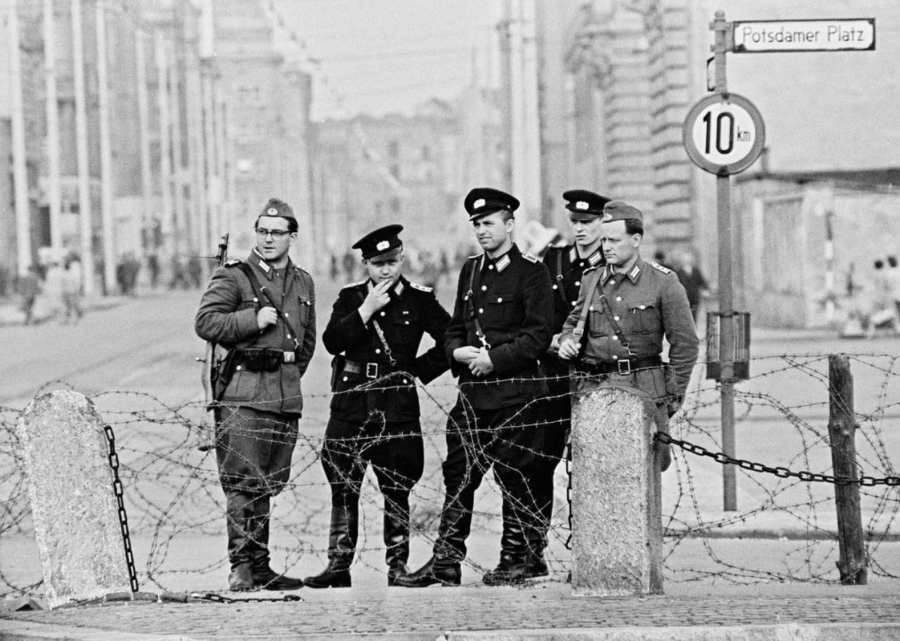
August 1961 the beginnings of the Berlin Wall – East German soldiers put up barbed wire to start with. Photo retronewser.com
It reminds me of a story I heard some years ago on the BBC, about the erection of the Berlin Wall. It featured an eye witness account from a British military officer* who went to assess reports that a barrier had started to be put up between the Soviet and British sectors of Berlin, in the early hours of 13 August 1961.
It went something like this:
“so I went to investigate and at [place?] I found a detachment of British troops manning a position along the dividing line, watching East Germans putting in concrete foundations and a barbed wire barrier. I asked them if they knew what was happening and they said ‘no’ but they had been wondering. I said “those chaps over there are building a wall between the British sector and the Russians. You are on the wrong side of it. So you had better move””.
The point being that although tensions had been rising for some time, when The Wall started to go up it took most people by surprise, even the troops (in several places what became the Wall did not exactly follow the sector borders, which up to that point were only marked by some rusty metal posts).
Big Tech AI is already causing widespread social anxiety on top of the impact of social media on children. From data-centres and their water and energy demands to the erosion of truth, the disabling of learning in education and undermining of law, journalism and science, and the loss of authenticity from the creative arts.
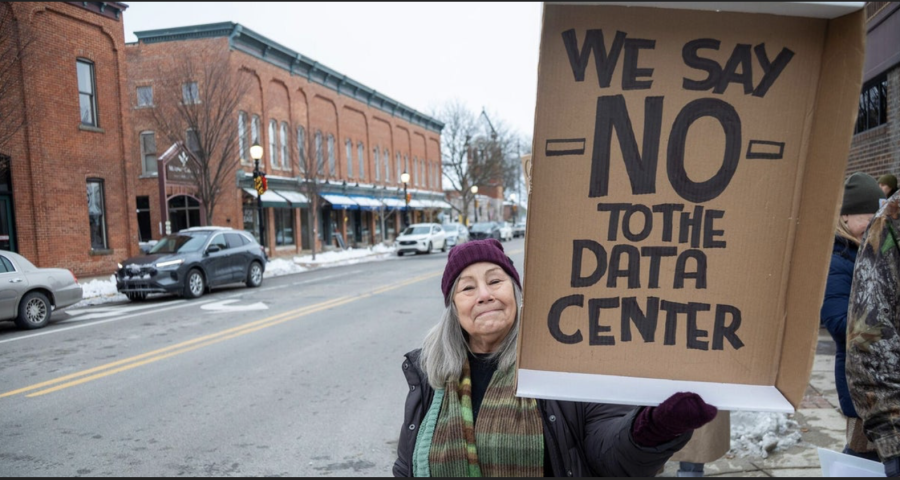
photo: cbsnews.com
The AI spiral of blind innovation sucking in vast investment spins political FOMO – Fear of Missing Out – which hypnotises politicians, and that inhibits regulation. Last year in AI’s War on Truth I suggested ten factors which might bring the AI spiral down to ground: impact on mental health, economics (eg financial implosion), product safety, Sovereign AI, fire-walling (the fences), environmental damage (via data centres), Creative IP Rights, technological/market limits, the volume of harms, and the scandal of ‘hallucinations’. Already some items on that list sound rather quaint, so fast has AI developed.
On the other hand, grass-roots opposition to data-centres is also spreading like wildfire, from Chile to Scotland to Australia to Malaysia. 70% of Americans oppose them being built in their area. As to Big Tech, in California, Meta was forced to settle for $16.7bn in a social media addiction court case against 29 States, and it has had to abandon a plan to replace up to 60% of its own staff with AI. A survey found the more scientists have used AI, the less they trust it and the less capable they think it is, while as models become more ‘capable’, it turns out they hallucinate not less as was expected but more.
Perhaps most serious for Big tech, in the US AI is even more unpopular than ICE. Worse still, young people particularly distrust AI bosses. Pew found US concern about AI rose from 37% to 52% in 2026, and for the first time a majority under 30 are more ‘concerned’ than excited about it. The current global MIT survey found the country with the greatest increase in people agreeing ‘products and services using artificial intelligence make me nervous’ was tech-obsessed India.
These are just some of the indications that the magical aura of Silicon Valley has dimmed significantly in less than a year, while concerns about AI have started to crystallise and opposition to organise. Even governments like the UK’s which imported US-style unadulterated enthusiasm for AI in 2024, will now be infused with some doubt.
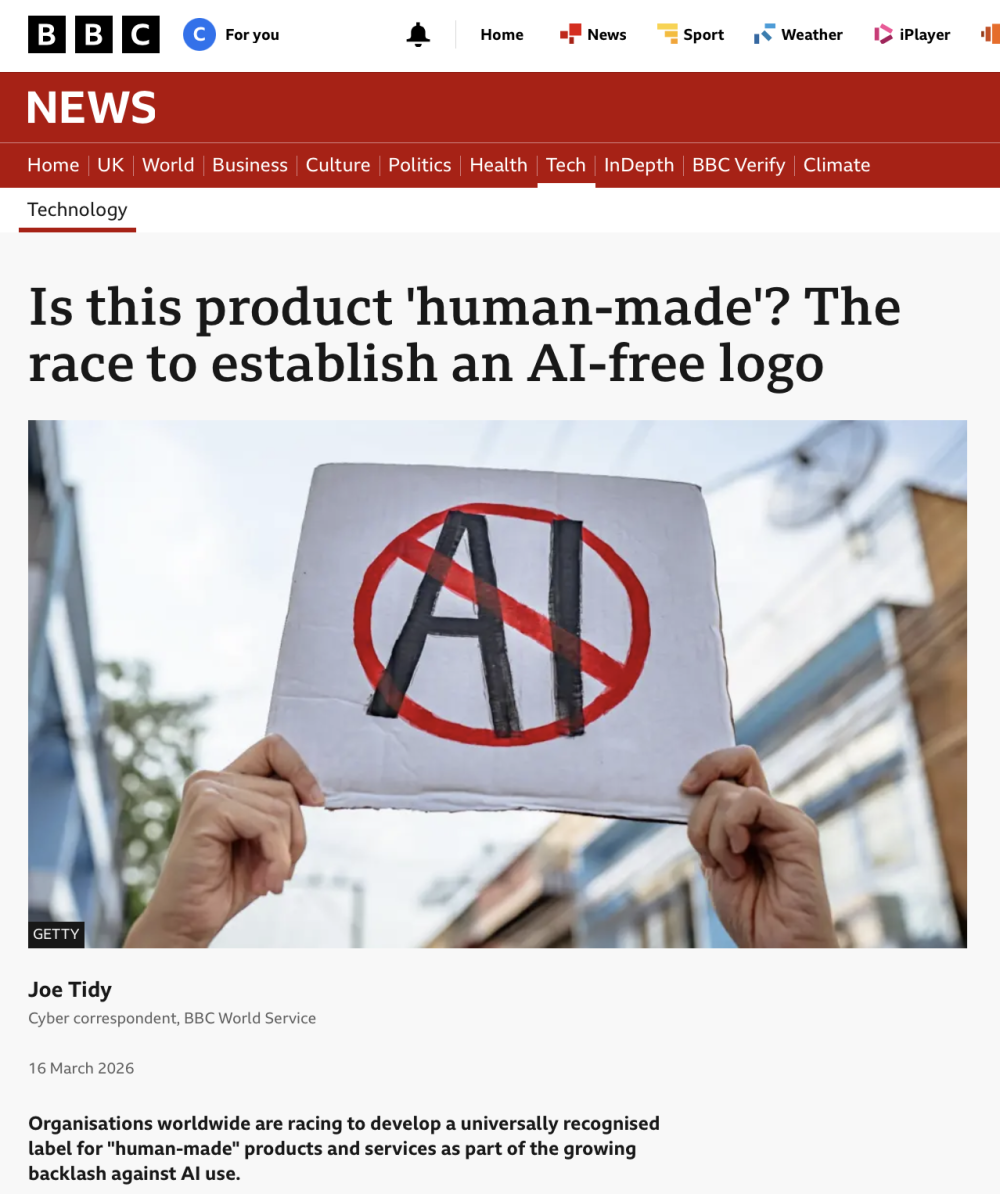
Partly to stay in line with requirements of the EU’s AI Act (and California’s AI Transparency Act) to make AI images or audio identifiable but also because of customer concern, Spotify and TikTok have both enabled or undertaken labelling of AI content. Likewise YouTube, LinkedIn, and Substack have also moved to identify, label, or limit some AI-generated content. Even if nearly all the ‘rules’ are mostly voluntary, they indicate an unmistakable direction of travel as AI ‘de-socialises’.
Many universities are still committed to embracing AI at a corporate level but many academics are in despair at its impact on real learning, and some are resorting to old-school analogue and human face to face assessment to avoid the polluted digital domains. Businesses need people as customers – they probably won’t be selling to agents anytime soon – and people have agency. Some will be putting up “AI-free” fences.
Civil Society – NGOs and not for profits – need to read these tea-leaves and decide which side of those fences they will be on, and soon.
Where the lines are drawn on “AI-free” will be case specific and driven by grossness of famous cases, opportunity and many other factors. There may be no good homologue from the past.
As a pollutant of truth, AI is already similar to plastic. Its explosive global adoption was driven by being super-convenient, and it escaped effective regulation before it was realised to also be toxic. Pervasive AI would still leave Pioneers to start ‘free from’ businesses as happened with GM- or pesticide-free food. In the UK and probably elsewhere, some young highly educated people are already seeking out AI-proof authentic craft livelihoods. AI might go that way: stimulating a lot of AI-free start ups and lifestyle choices.
Or, as some AI advocates hope, it will be like writing or the invention of printing, ultimately ethically and morally seen as in itself, neutral. Given the centralised production and accrual of benefits as wealth, which is already causing all sorts of real world effects, personally I doubt that’s how it will go. The strategies (Peter Thiel’s dominant first mover) and the mentality (hyper-scaling domination) are more like the ‘Kings’ of the seven oil ‘Super Majors’ of the C20th than Johannes Gutenberg.
One of the worst cases for well intentioned AI users and developers is that it comes to be seen like tobacco and smoking, and thence progressive expansion of smoke-free-zones. The dynamics of the child-harm social media court cases are already analogous: starting with places (the home, the child’s bedroom) which should be ‘sacrosanct’, and centred on ‘blameless’ victims (children and uninformed/ deceived parents).
Meanwhile the financial markets are wondering about the growing gyre of investment circulating between tech supplier Nvidia and its AI firm customers, and asking who will survive when, rather than if, the bubble bursts, as it did with railroads and dot.com companies. When that happens the effect on credit could reach far beyond ‘tech’ itself, similar to the 2008 credit crunch which triggered recession affecting all of society.
On ‘X’, analyst @HedgieMarkets posted on 25 August that ‘Anthropic is expected to tell IPO [its impending public stock market flotation] investors that its total addressable market exceeds $30 trillion. That’s roughly the entire GDP of the United States’. Anthropic reaches this astronomical sum by assuming it will take all possible business to be done with AI models. As Hedgie points out, institutional investors will recognise this as financial hyperbole but ordinary retail investors who buy after them, may not.
A recent FT report ‘The Multiplying Risks of Financing Datacentres‘ noted ‘By 2030, tech companies are expected to pour $7tn into data centres — enough money to feed every person in China for three years’.
Although they control permitting of data centres and so could curtail or stop the entire spiral, few politicians have yet said much about whether this is actually a good use of investment. Might it for instance, be better spent on hastening the real-world transition from fossil fuels to renewables to help fix climate change? When the AI wonder-product hysteria started just a couple of years ago it was often suggested that AI could “help solve problems like climate change”. You don’t hear that now, both because it’s patently obvious that we already know what’s needed, and because Gen AI has proven itself so unreliable in practice.
***
And finally, if you are in a public interest cause group, do think about the fence issue. I had a feeling that the fence between human-made and AI made may turn out to be, like the Berlin Wall, the sort you can’t really sit on.
***
(Throughout this and my previous blog I’ve referred to ‘AI’ in an unqualified way, which is what almost all non-technical commentary does but in reality there are non-generative AI systems which often pose very little social risk. Such as specialised medical applications. They however, usually have tiny requirements for data and processing compared to the ambitions of the ‘super intelligence’ chasers whose vision is for AI to run entire economies and societies instead of humans).
____________________________________________________________
*The story was in a BBC radio programme but I can’t find it online. There is one obvious candidate, Brigadier L F Richards in charge of the Military Police but it’s not in his published recollections. If anyone knows where the recording is to be found, please let me know.


