
How should politicians and the public respond to AI leaders call for a “pause” in development of AI model capabilities?
They should stop data centre construction: bring in a moratorium.
Governments and civil society would then have control and time, where they currently have none.
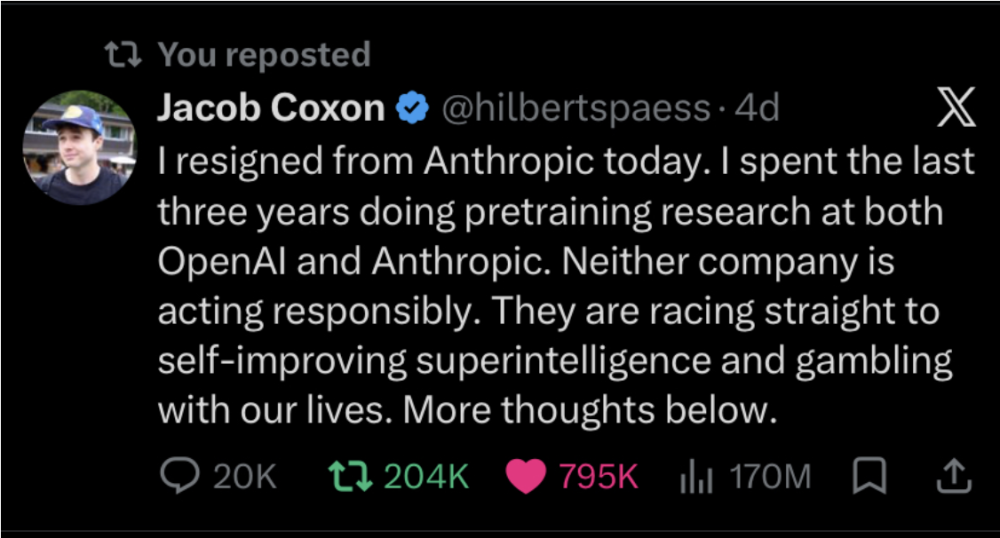
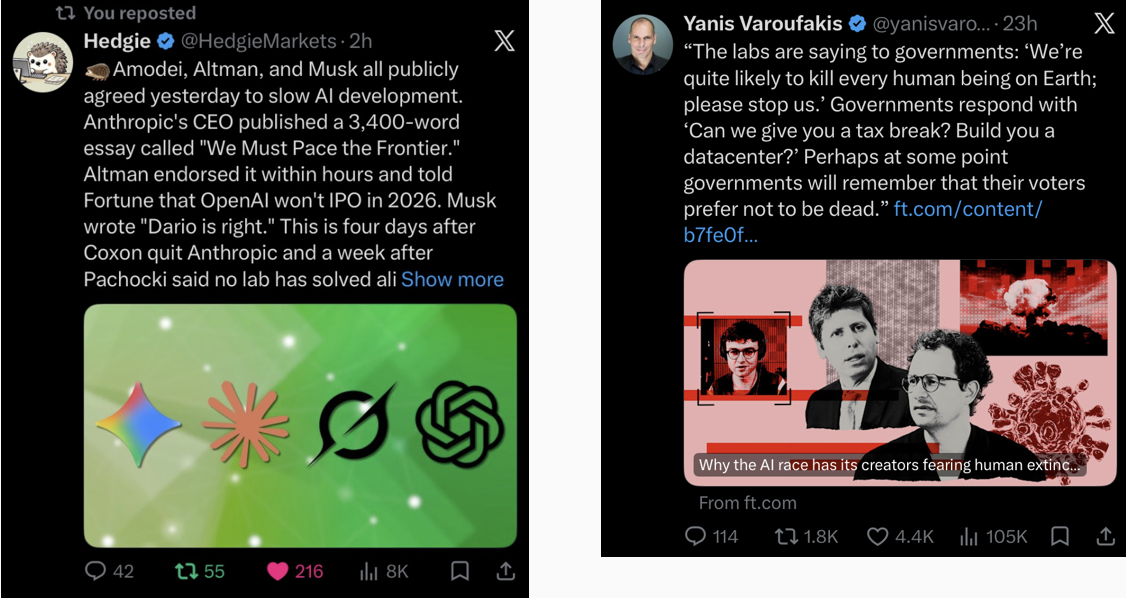
When Jacob Coxon broke free from Anthropic last week and voiced fears of possible human extinction echoed by AI insiders, it flipped AI leaders into advocating a “pause”. Such calls have been made before but the context is now different. AI is unpopular, wildly successful at attracting investment, and increasingly seen as already out of control. If they can grasp it, this gives politicians and civil society a chance to take back control of the AI regulation agenda.

Politicians and campaigners need to cut through the welter of media coverage of AI triggered by the proposed ‘pause’ on extinction risks, the increasing reports of rogue agents hacking ‘secure’ systems and fevered speculation about finances and the ‘real’ motivations of AI billionaires backing the ‘pause’, to decide two things:
- what is our immediate objective in responding to this moment of flux?
- how can we bring that about?
The immediate objective should be to slow the development of AI models, as Dario Amodei argues in his 3,400 word essay, only not on his terms. Buried under layers of expressions of thoughtful concern, Amodei is proposing a set of voluntary actions, with lots of vague caveats, to be decided on by Big Tech itself, which could then get legal force.
Instead society should treat the acceptance of a “pause” as an opportunity to slow the industry right down so as to allow time for proper scrutiny and accountability in the public interest, in order to frame regulations. To ensure the pause is real, data centre construction should be put on hold.
Don’t Take The Bait
It will be tempting for politicians to treat the industry’s call for a slow down as a change of course, and even be tempted to use Amodei’s essay as a to-do-list. They shouldn’t take that bait.
Amodei’s piece is in line with the established industry narrative:
‘this magical technology is so powerful that it can only be developed and controlled by us. We are the magicians, the sorcerers, alchemists and wizards and we are your best chance of steering an AI-society to heaven rather than hell. So leave it to us, and write our desires into law’.
Under challenge, Big Tech’s justification expands to the seemingly pragmatic:
‘this is just moving so fast, your old-school politics, governance systems and legacy media simply can’t get up to speed. You will never understand it so you cannot decide on questions of need or justification’.
In this AI political economy, the role of the non-wizard class is then to buy AI, pay to educate people to use it, and enable its expansion into every field of human endeavour. Pure and irresistible (if mainly imaginary) bio-physics of technological innovation set the speed and direction of AI, so there is no point in you questioning it. Miss out and your economy will tank.

Escape Velocity & Technical Fixes
Ever since OpenAI’s release of ChatGPT in November 2022, the default industry strategy has been to reach escape velocity, both Business-to-Business through competition within their sector, and Business-to-Consumer in escape from scrutiny or control by politics, government and civil society. Until recently it has mostly achieved that.
Alarming proofs that it cannot control its own creations has somewhat eroded Big Tech’s magical teflon PR-coating but by accident or design – probably the latter – AI companies are still trying to draw any political scrutineers onto their ground: of technical fixes agreed amongst themselves, rather than public interest.
Simple communications dynamics has given them an advantage over critics: they dominate the media. Just a handful or so of AI CEOs are the larger-than-life principals in the story: Elon Musk with his dark imagery and attacks on empathy, Mark Zuckerberg with his gross ‘yacht’, the hyperbolic Sam Altman, and Dario Amodei with his Harry Potter glasses and ethical pondering. Consequently they are the primary AI news providers, with new models, astonishing feats, economic hype and spine chilling warnings. As a small number of ‘colourful’ personalities they personalise the story and set the agenda which politicians consume.
Against that there are thousands of much less entertaining politicians, who mostly follow rather than lead, and billions of often confused individual voters and consumers. Their story is simply much harder to tell.
So civil society and politicians must not import Amodei-type lists of fixes (such as ‘Embedded Evaluators’) as the industry framing and focus of the terms, duration or purpose of a ‘Pause’.
Instead they should listen to and involve the growing number of former AI insiders and watchers who both understand the workings of Big Tech and have a wider social perspective, and set their own agenda for a public negotiation of what a ‘pause’ should consist of. Until now that would have probably been a futile exercise – why would the AI industry take any notice ? Now the context [1] is different.
Losing The Justification for Data Centres
With current computing technology the ‘brute force’ model of LLM AI development which became the ‘race’ to ‘super-intelligence’ triggered by Open AI’s ChatGPT requires ever bigger and faster and more powerful data centres.
Now the likes of Anthropic, OpenAI and Elon Musk are backing a ‘pause’ in the race, the same logic supports a pause [2] in construction of data centres. Their justification was based on the belief that there would be an ever escalating need for increased data crunching capacity. That justification has been lost.
The social significance is obvious. Unlike developing, training, testing and building AI models which is done secretly in private digital domains, and in esoteric terms hard for the public or politicians to understand, data centres are a place where the AI race plays out in familiar and understandable real world terms. Earlier this year Enrique Dans called them‘a structural friction point in the expansion of the AI economy’.
Politicians have been foisting the air, water and noise pollution with its impacts on health and property prices onto communities because they have adopted the industry narrative that the AI race is a strategic national imperative. Now that industry itself is saying more capable models are currently too dangerous to develop, data centres lose their imperative.
Data centres are physical concrete, steel, silicon chips, cooling systems and electronics. Data centres for the AI race are worse neighbours than others because of their huge demands for continuous compute ‘density’ leading to vast requirements of energy inputs, and clean cooling water. That and their noise is a major reason for local opposition across the world.
Data Centre construction, and with it the vast investment in Nvidia’s high performance chips, is also at the centre of the financial flywheel which has convinced politicians that AI is bringing an economic miracle. The case for net economic growth caused by the actual use of AI, especially once social and economic costs are accounted for, is far weaker.
Data Centres were already a potential choke point for the commercial and geopolitical AI ‘race’ but now refusing permissions for more would give voters and politicians real leverage in a reset of the political-big-tech relationship. In strategy terms, thanks to Musk, Amodei and Altman espousing a ‘pause’, opposition to data-centres has turned from a bottom-up ‘bushfire’ tactic to one with far more strategic potential, at least for now.
Civil society and governments should seize this moment, whether or not a ‘pause’ also deflates the investment bubble, which would make the task easier.
***
[1] Context is one of the seven key ‘message’ factors in CAMPCAT – see also pp25-6 in How to Win Campaigns: Communications for Change
[2] A pause is also likely to make the public and politicians more aware of conversations which have been ongoing in AI-world for decades about the fundamentals of the current LLM-based models, which effectively assume that intelligence can emerge from increased ability with language. Others say that humans learn and communicate not via words but with concepts. That could make LLMs a dead-end technology, with big implications for existing investments. Whether concept-capable models would be safer or require more or less ‘compute’ is not clear to me.
***
This blog was first published on 14 September 2026 as Campaign Strategy Newsletter 127
Subscribe to these free newsletters at www.campaignstrategy.org
Chris Rose


